How to Find a Trusted F150 Performance Shop Near Me

Last Updated: October 28, 2026
Quick Summary
To find a trusted F150 performance shop near me, verify that the shop asks about your engine, trim, and model year before quoting, has dyno access or a documented tuning partner, and puts emissions status and warranty terms in writing. A real F150 performance shop plans the whole build, including transmission, cooling, and fuel system support, rather than quoting horsepower alone.
- Ask five vetting questions and compare written answers from two or three shops side by side.
- Request before-and-after dyno sheets from a comparable truck on the same dyno.
- Whipple Gen 6 Stage 2 kits run $9,999.99 for 2021-2023 and $10,299.99 for 2024-2026 5.0L trucks.
- Confirm fitment by part number and engine code, not by a product page saying fits F-150.
- Paul's Automotive Engineering is a licensed distributor for Whipple, Ford Racing, and Procharger.
Table of Contents
- What Separates a Real F150 Performance Shop From a General Repair Bay
- Questions to Ask a Performance Shop Before You Book
- How to Read Ford Performance Shop Reviews Without Getting Fooled
- F-150 Modification Costs: What Parts and Labor Actually Run
- F-150 Performance Upgrade Installation Time and Turnaround
- Matching Upgrades to Your F-150's Engine, Trim, and Model Year
- Email Paul's Automotive Engineering to Plan Your F-150 Build
- Frequently Asked Questions
What Separates a Real F150 Performance Shop From a General Repair Bay
Finding a trustworthy F150 performance shop near me starts with one distinction: a general repair bay fixes what's broken, while a performance shop makes a plan for what you want the truck to do. That difference shows up in the questions staff ask, the equipment on the floor, and whether anyone can explain how a supercharger, tune, and fuel system work together before you spend a dime.
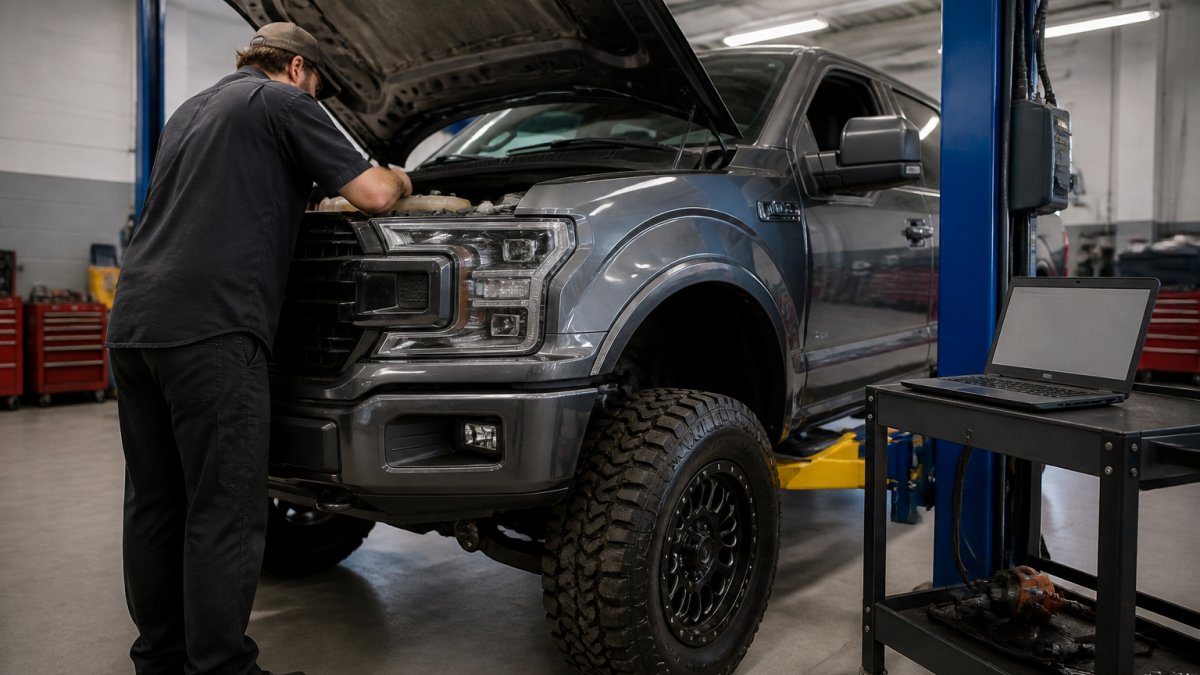
A shop that handles oil changes and brake service all day may be perfectly honest, but that doesn't mean it can plan a 700-horsepower build without blowing your engine. Performance work is a different discipline.
Signs of F-150-Specific Expertise
Look for these markers before you hand over the keys:
- Staff who ask about your engine, trim, and model year before quoting anything
- A dyno on site, or a documented tuning partner who has one
- Brand-name parts relationships, not generic "performance" labels
- Experience with Ford trucks specifically, including the 5.0L Coyote and EcoBoost platforms
- A written plan for how the upgrade affects the transmission, cooling, and fuel system
If a shop can't tell you how a supercharger kit interacts with your truck's factory calibration, keep looking. If you want to understand why forced induction changes a Ford's character so much, it's worth reading about why you should install a supercharger on your Mustang or Ford before you compare shops.
Questions to Ask a Performance Shop Before You Book
Most shop-selection advice stops at "ask about experience." Frequently asked questions cover the shop's services and history. That question is too easy to answer with a nod. The useful version is a short interview with evidence requests, and it should be specific to your truck. Bring your VIN, your engine code, and a written goal (towing, daily drivability, drag strip, or off-road) before you call.
The five-question vetting script
- "What exact engine and model year are you quoting, and what is the calibration strategy?" The 2.7L EcoBoost, 3.5L EcoBoost, and 5.0L Coyote each have different calibration paths, and the 2021-2023 and 2024-2026 5.0L trucks use different supercharger hardware and calibration.
- "Who performs the tuning, and can I see a before-and-after dyno sheet from a comparable truck?" Installation and calibration are separate skills.
- "What supporting modifications does this build require, and what happens to the transmission, cooling, and fuel system?" A supercharger kit is not a standalone part.
- "What is the warranty picture, and is the part emissions-legal for my model year?" Ask whether the part carries a CARB Executive Order (EO) for your specific year, engine, and trim, and whether the shop will put that in writing. Ask how the manufacturer warranty interacts with the factory Ford warranty.
- "What is the all-in quote, including labor, tuning, fluids, dyno time, and tax, and what could change it?" Request line items.
Evidence to request before you book
- Dyno sheets from a truck with your engine and a similar build, showing baseline and post-upgrade pulls on the same dyno.
- A written build plan that lists parts, part numbers, labor hours, and the order of operations.
- A reference customer who did a comparable build, ideally within the last year.
- The warranty terms in writing, including duration, what is covered, and who performs the remedy.
- A parts availability check with an estimated ship date, not just "in stock."
Red flags that should end the conversation
- Quoting horsepower without asking your engine, trim, or model year.
- No dyno access and no documented tuning partner.
- Refusing to put the emissions status or warranty terms in writing.
- A quote that is a single number with no labor or calibration line.
- Pressure to buy parts before confirming fitment by VIN.
How to Read Ford Performance Shop Reviews Without Getting Fooled
Ford performance shop reviews are only as useful as the detail behind them. A five-star review that says "great shop" tells you nothing.
Read reviews with a filter:
- Skip the generic praise. Look for reviews that mention a specific engine, kit, or problem solved.
- Weight the middle ratings. A three-star review explaining a delay is more informative than ten perfect scores.
- Check for patterns, not outliers. One bad review happens. Five mentioning the same tuning issue is a signal.
- Look for follow-up. Shops that respond to criticism with specifics tend to handle problems well.
A common mistake is judging a performance shop by its Google rating alone.
F-150 Modification Costs: What Parts and Labor Actually Run
F-150 modification costs vary widely by platform and ambition, and any shop that quotes a single number without asking about your engine is guessing. The parts themselves are the biggest variable, and the labor follows the complexity of the install.
Here's how the pricing breaks down for a few common upgrade paths we carry:
| Upgrade | Product | Price | Best For |
|---|---|---|---|
| Stage 2 supercharger kit, 2021-2023 5.0L | Whipple Gen 6 Stage 2 | $9,999.99 | Owners chasing 775 hp with a bolt-on kit |
| Stage 2 supercharger kit, 2024-2026 5.0L | Whipple Gen 6 Stage 2 | $10,299.99 | Newer Coyote trucks, up to 805 hp |
| Performance calibration, 2.7L EcoBoost | Ford Performance M-9603-F27 | $639.99 | Budget-friendly power and throttle response |
| Performance calibration, 3.5L EcoBoost | Ford Performance M-9603-F35 | $654.99 | EcoBoost owners wanting a factory-backed tune |
Labor and tuning sit on top of parts. Want to see real pricing on a flagship kit before you call? Browse the 2024-2026 Ford F-150 5.0L Gen 6 Stage 2 Whipple Supercharger Kit to gauge the parts side of your budget.
F-150 Performance Upgrade Installation Time and Turnaround
If you're weighing whether to install upgrades yourself or have a shop handle it, our guide on whether installing an F150 supercharger kit is a DIY job walks through what's realistic for a home garage versus a professional bay.
Ford F150 5.0L Gen 6 Stage 2 SC Kit 2021-2023 →
Matching Upgrades to Your F-150's Engine, Trim, and Model Year
Matching upgrades to your truck comes down to three variables: engine, trim, and model year. A kit built for a 2021-2023 5.0L won't fit a 2024-2026 truck, and a calibration for the 3.5L EcoBoost doesn't apply to the 2.7L. The practical skill is verifying fitment before you pay, then planning the supporting parts and the paperwork together.
Step 1: Confirm your exact build
Start with the door jamb sticker and the VIN. Do not rely on the badge alone; trims and engine availability changed across generations. Write down:
- Model year and generation
- Engine displacement and engine code (for example, 5.0L Coyote, 2.7L EcoBoost, 3.5L EcoBoost)
- Trim and drivetrain (2WD or 4WD)
- Any factory packages that affect cooling, fuel, or exhaust
Step 2: Check fitment by part number, not by description
A product page that says "fits F-150" is a starting point, not a confirmation. Match the manufacturer's part number to your model year and engine. The most common mistake is buying a kit based on a forum post instead of the actual engine code. The Whipple Gen 6 Stage 2 kits are listed for different model-year ranges: 2021-2023 and 2024-2026. The Ford Performance 3.5L calibration is listed as 50-state approved. Verifying these specific compatibility requirements ensures that the hardware remains compatible with the baseline parameters established by stage 1 tuning.
Step 3: Plan the supporting modifications
A power adder changes the load on the rest of the truck. Before you choose a kit, plan for:
- Transmission calibration and cooling. More torque changes shift strategy and heat load. Ask whether the build includes a transmission tune and whether an auxiliary cooler is recommended.
- Fuel system headroom. Confirm whether the kit's calibration assumes stock injectors and pump or requires upgrades, and at what power level.
- Heat management. Superchargers add underhood heat. Ask about heat exchanger capacity, pulley selection, and whether the shop logs intake air temperatures on the dyno.
- Exhaust and emissions hardware. Headers and mid-pipes can change emissions status. Confirm what is legal for your model year before buying.
- Brakes, tires, and suspension. A lifted truck with more power needs matching stopping and stability work. Plan these as part of the build, not after.
Step 4: Understand emissions and warranty before you buy
Emissions legality is model-year and part-specific. Ask whether the part carries a CARB Executive Order for your exact year, engine, and trim, and keep the documentation. For warranty, understand that aftermarket modifications can affect the factory Ford warranty on related components, and that the manufacturer's own warranty on the performance part is separate. Ask the shop what it will put in writing about workmanship and what happens if a part fails.
Step 5: Set a measurable goal
Decide what success looks like before the build: a dyno number, a quarter-mile time, towing behavior, or drivability.
To browse parts that match your truck's engine and trim, see our Ford F150 product lineup.
Email Paul's Automotive Engineering to Plan Your F-150 Build
The hardest part of finding a good performance shop isn't the search, it's knowing which questions to ask and which parts actually fit your truck. Get those two things right and the rest follows.
At Paul's Automotive Engineering, we're a licensed distributor for Whipple, Ford Racing, and Procharger. If you're ready to plan your build, email us to schedule your appointment.
Frequently Asked Questions
How do I find a reputable F-150 performance shop near me?
Start with shops that name Ford and F-Series work directly, then check customer reviews with specifics rather than star ratings alone. Ask whether they are an authorized dealer for the brands they sell.
What should I ask a performance shop before booking an F-150 upgrade?
Ask four things: what evidence they can provide about results, whether the product listing identifies emissions approval for your vehicle, what warranty information is available, and how long the truck will be in the bay. Vague answers on any of these are a reason to keep looking.
How much does F-150 performance tuning cost?
It depends on the product. The Ford Performance calibration for the 2021-2023 2.7L EcoBoost is $639.99 and includes the ProCal 4 tool; the 3.5L version is $654.99 and also includes the tool. The 2021-2023 F-150 5.0L Stage 2 kit is $9,999.99, and the 2024-2026 version is $10,299.99.
Will performance modifications affect my F-150 warranty?
The listed 2021-2023 F-150 2.7L and 3.5L Ford Performance calibrations include a 3-year/36,000-mile warranty from the vehicle's in-service date when installed by a Ford dealer or an ASE/Red Seal certified technician. Check the product listing for the applicable terms.
Most owners start with a horsepower goal and work backward into parts. We'd rather start with your truck and build forward from there. Reach out to Paul's Automotive Engineering, tell us your engine, trim, and model year, and we'll put together a plan that holds together as a system rather than a pile of bolt-ons.


Leave a comment