

Mustang GT Dyno Tuning Benefits: What You Really Gain

Last Updated: October 23, 2026
Quick Summary
Dyno tuning measures and adjusts your Mustang GT's engine calibration on a chassis dynamometer under real load, so fuel and timing match what your specific 5.0L Coyote is actually doing at wide-open throttle. The biggest gains land under the curve: sharper throttle response, stronger midrange pull, and safer air-fuel ratios.
- A chassis dyno reads wheel horsepower, so compare before-and-after runs on the same dyno, day, and conditions.
- A custom dyno tune on a near-stock Mustang GT commonly runs $500-$800 with three to five pulls.
- We halt a pull if knock is detected, air-fuel ratio drifts lean, fuel pressure drops, or intake temps climb out of range.
- Tell your tuner the exact engine generation, transmission, and fuel you run, since calibration strategy changes across Gen 1 through Gen 4 Coyotes.
- A canned tune fits a near-stock car, while a custom dyno tune fits a car with real modifications.
Table of Contents
- What Dyno Tuning Actually Does for a Mustang GT
- Mustang GT Dyno Tune Horsepower Gains: Realistic Numbers
- Mustang GT Dyno Tune vs. Canned Tune: Which Fits Your Build?
- The Mustang GT Dyno Tuning Process, Step by Step
- Mustang GT Dyno Tune Cost and Value by Build Stage
- Model-Year and Engine-Generation Differences That Change the Tune
- Fuel Economy, Combustion Efficiency, and Daily Drivability
- Conclusion
- Frequently Asked Questions
What Dyno Tuning Actually Does for a Mustang GT
Dyno tuning is the process of measuring and adjusting a car's engine calibration on a chassis dynamometer while the car runs under load. A canned tune ships with assumptions baked in; a dyno tune reads what your specific 5.0L Coyote is actually doing at wide-open throttle, then adjusts fuel and timing to match. That's why two Mustang GTs with identical bolt-ons can leave a shop with very different results.
Chassis Dyno Basics and Why Wheel Horsepower Matters
A chassis dyno measures power at the drive wheels, not the crankshaft. The number you see is wheel horsepower, or whp. Driveline loss means whp always reads lower than the factory crank rating, so comparing a dyno sheet to a brochure figure is a waste of time. What matters is the before-and-after on the same dyno, same day, same conditions.
Mustang GT Dyno Tune Horsepower Gains: Realistic Numbers
Realistic gains depend on your starting point. A stock Gen 3 Coyote with a custom dyno tune typically picks up modest peak power, with the larger benefit landing in the midrange and in how the car responds. A car with headers, an intake, and a manifold sees more, because the tune can finally take advantage of the airflow those parts added.

Torque, Throttle Response, and Power Delivery
Where a dyno tune earns its keep is under the curve. Peak horsepower gets the attention, but torque and power delivery are what you feel on a back road or freeway on-ramp. A properly calibrated car pulls cleaner out of a corner, holds a gear longer without falling flat, and sharpens throttle response because the calibration matches pedal input to actual airflow.
- Sharper tip-in and cleaner part-throttle response
- Stronger midrange pull on the street
- Smoother power delivery through the rev range
Mustang GT Dyno Tune vs. Canned Tune: Which Fits Your Build?
The short answer: a canned tune fits a near-stock car, and a custom dyno tune fits a car with real modifications. A canned tune is a pre-built calibration written for a general combination of parts, affordable, fast, and adequate for a stock or lightly modified Mustang GT. A custom tune is written for your car on a dyno, with data logging and air-fuel ratio checks guiding each revision.

| Factor | Canned Tune | Custom Dyno Tune |
|---|---|---|
| Best for | Stock or light bolt-ons | Headers, intake, manifold, forced induction |
| Calibration basis | Generic part combination | Your car's logged data |
| Air-fuel ratio check | Assumed | Measured under load |
| Time in shop | Minutes | Hours |
| Safety margin | Conservative, general | Tuned to your fuel and conditions |
When a Canned Tune Is Good Enough
A canned tune makes sense when your car is close to stock and you want a simple calibration upgrade without chasing every last bit of power. The catch is that it can't see your fuel quality, altitude, or the quirks of your specific engine, it assumes. On a modified car, that assumption isn't good enough.
When a Custom Dyno Tune Pays Off
A custom dyno tune pays off the moment your parts list outgrows a generic calibration. Long-tube headers change airflow. A different intake changes how the mass air meter reads. Forced induction changes everything. In those cases, a tune written on a dyno lets us verify air-fuel ratio and ignition timing under real load instead of trusting a one-size file. If you're adding parts, we'd pair the install with a proper calibration rather than leaving power and safety on the table.
The Mustang GT Dyno Tuning Process, Step by Step
Here's how a session runs at our shop. The order matters, because each step protects the next.
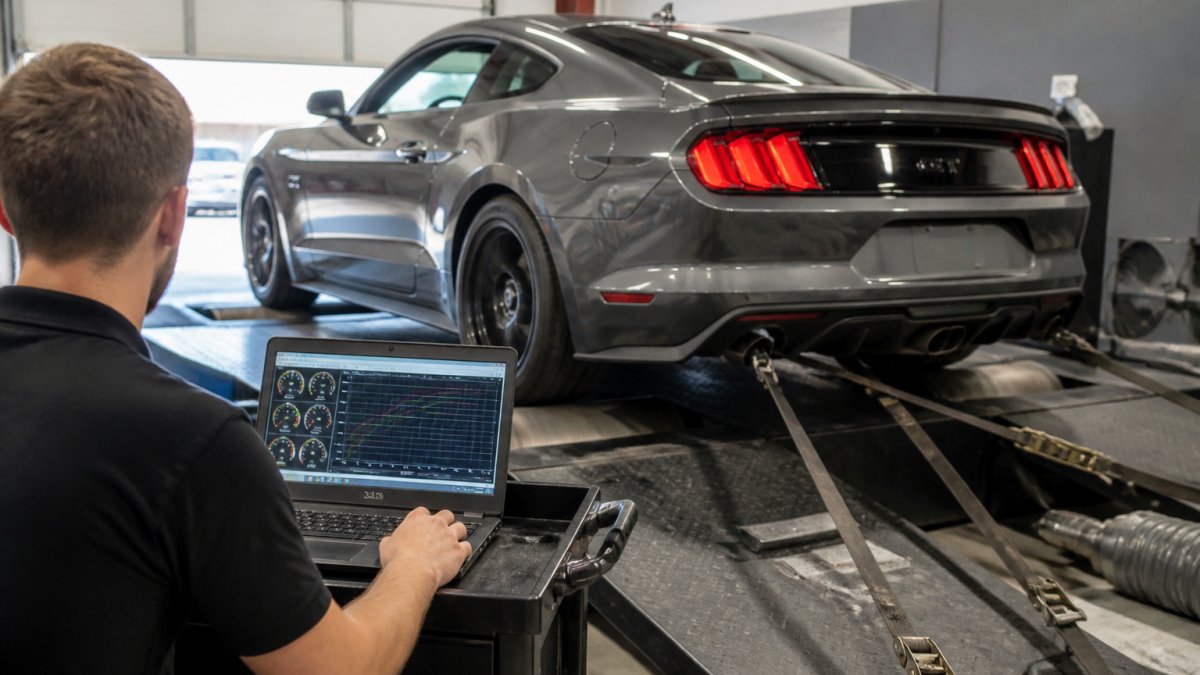
- Pre-tune inspection. We check plugs, fluids, belt condition, and for any stored engine diagnostics codes before the car goes near the rollers.
- Strap-down and safety check. The car is secured, the cooling fan is set, and tire condition and pressures are confirmed.
- Baseline pull. A wide-open-throttle run in third or fourth gear establishes the starting power curve.
- Data logging. We log air-fuel ratio, ignition timing, knock, and intake temps across the pull.
- Calibration revisions. Fuel and timing are adjusted, then the car is re-pulled to confirm the change.
- Verification pulls. Repeatable results across two or three consistent runs confirm the tune is stable.
- Street check. A short drive confirms drivability, part-throttle manners, and no check-engine light.
Baseline Pull, Data Logging, and Air-Fuel Ratio Checks
The baseline pull is the reference point for everything else, without it, you have no way to prove a gain. Data logging turns that pull into usable information: air-fuel ratio at each rpm point, timing advance, and whether the knock sensors are pulling timing. Lean conditions under load are what we watch most closely, because a lean mixture at wide-open throttle is how engines get hurt.
Safety Checks and Tuning Stop Conditions
Every session needs a stop line. We halt a pull if knock is detected, air-fuel ratio drifts lean, fuel pressure drops, or intake temperatures climb out of range. Those aren't failures of the tune, they're the tune telling us the hardware needs attention first. Fuel quality matters too: a car calibrated on premium doesn't tolerate a tank of regular under load, and the calibration should reflect what the owner actually runs.
Mustang GT Dyno Tune Cost and Value by Build Stage
Cost scales with how much calibration work your combination needs, so the honest way to talk about it is in ranges. Across the industry, a custom dyno tune on a near-stock Mustang GT commonly runs $500-$800 for a session with a baseline pull, several revisions, and verification pulls.
Session length tracks the same curve. A stock or light-bolt-on car is usually a two-to-three-hour appointment with three to five pulls. A headers-and-intake car is often a half day.
- Stock or light bolt-ons: roughly $500-$800, 3-5 pulls, 2-3 hours
- Headers and intake: roughly $700-$1,000, 5-8 pulls, half day
- Manifold and cam changes: extended session with careful midrange and part-throttle work
When a Dyno Tune Is Worth It Versus a Canned or Remote Tune
A canned tune typically costs a few hundred dollars and takes minutes to flash. A remote or email tune sits between canned and dyno tuning: you log the car, send the file, and receive revisions, usually for a few hundred dollars plus the cost of the logging device. The value question isn't which is cheapest, it's which one can actually see your car.
2" Stainless Headers & H.O. GREEN Cat. Conn. Kit. 2015-2026 Mustang GT/D.H. →
A canned or remote tune is entirely adequate on a stock or lightly modified car, and the dyno premium buys precision and safety margin rather than a large peak-power jump. If you are adding long-tube headers, our 2" Stainless Headers & H.O. GREEN Cat. Conn. Kit for 2015-2026 Mustang GT is a natural pairing with a custom calibration, since the tune is what lets the headers deliver their airflow benefit.
Model-Year and Engine-Generation Differences That Change the Tune
The Coyote has changed substantially since 2011, and the calibration has to follow. Treating every Mustang GT as the same car is one of the most common ways owners end up with a tune that underdelivers or, worse, runs on the edge. The differences break down by generation and affect fuel requirements, parts compatibility, and how much headroom the factory calibration leaves on the table.
Gen 1, Gen 2, and Gen 3 Coyote: What Actually Changes
Gen 1 (2011-2014) uses a 5.0L Coyote with port fuel injection and a factory calibration that responds well to intake and exhaust changes.
Gen 2 (2015-2017) revised the heads, intake, and valve train, and the calibration strategy changed with them.
Gen 3 (2018-2023) added dual injection, port and direct, along with a higher compression ratio and revised heads.
Gen 4 (2024+) continues the dual-injection approach with further calibration changes.
Transmission, Fuel, and Parts Compatibility
The transmission matters as much as the engine. A manual car and a 10-speed automatic need different calibration work around torque management, shift pressure, and how power is delivered on a pull, so a dyno session on an automatic should account for how the calibration interacts with the transmission, not just the engine.
Fuel is the other variable. If you are building a short block, our 5.0L Gen 3 Aluminator NA Short Block fits Gen 1 through Gen 4 heads with the matching gasket, which matters when you're mixing generations and need the calibration to match the final combination rather than the donor car.
Fuel Economy, Combustion Efficiency, and Daily Drivability
A good dyno tune can help fuel economy, but it isn't a fuel-saving device. Combustion efficiency improves when air-fuel ratio and ignition timing are matched to the engine's actual airflow, and a cleaner burn at cruise can show up as slightly better mileage. The bigger daily gain is drivability. A car that responds predictably at part throttle is easier to live with in traffic than one with a lazy pedal.
- Cleaner combustion at cruise from correct air-fuel ratio
- Predictable throttle response in stop-and-go traffic
- Consistent behavior on the fuel you actually buy
Conclusion
The real question isn't whether a dyno tune adds peak power. If you've added headers, an intake, a manifold, or boost, a measured calibration is how you protect the investment and get the power you paid for. Our team at Paul's Automotive Engineering has spent decades installing Mustang and Ford performance parts, and we'd rather log your car and show you the data than sell you a number.
Frequently Asked Questions
How much horsepower does a dyno tune add to a Mustang GT?
On a stock or lightly modified Mustang GT, a dyno tune typically adds modest peak horsepower, often in the low double digits, with the bigger gains showing up in mid-range torque and throttle response. The exact number depends on fuel quality, bolt-ons, and the baseline condition of the car. A proper baseline pull before tuning is the only way to know what your specific car gains, since wheel horsepower (whp) numbers vary from dyno to dyno and from car to car.
Is a dyno tune worth it for a stock Mustang GT?
For a completely stock Mustang GT, the dollar-per-horsepower return is smaller than on a modified car, so many owners wait until they add bolt-ons. That said, a dyno tune can still improve throttle response, drivability, and air-fuel ratio accuracy, and it gives you a documented baseline for future mods. If you plan to keep modifying, starting with a clean baseline and a custom calibration saves guesswork later.
How is a dyno tune different from an off-the-shelf or canned tune?
A canned tune is a pre-built calibration designed for a general combination of parts, while a dyno tune is built and verified on your specific car while it runs on a chassis dyno. The dyno session lets the tuner watch air-fuel ratio, ignition timing, knock, and power curve in real time and adjust fuel calibration and timing advance for your fuel quality and modifications. Canned tunes are cheaper and convenient; dyno tunes are more accurate for unusual combinations.
How long does a Mustang GT dyno tune take and what does it cost?
Most dyno tuning sessions run a few hours, including a baseline pull, data logging, several adjustment pulls, and a final verification pull. Cost varies by shop, dyno type, and how much custom work your combination needs, so ask for a quote based on your mod list rather than a flat advertised rate. Budget for the session plus any supporting parts, such as the Kooks 2-inch stainless headers and high-output green catted connection kit for 2015-2026 Mustang GT at $3,720.86, if you are adding exhaust flow before tuning.


Leave a comment