

How to Install a Mustang Supercharger: Step-by-Step

Table of Contents
- Mustang Supercharger Tools and Equipment You'll Need
- Mustang Supercharger Kit Compatibility: Will It Fit Your Car?
-
Step-by-Step Mustang Supercharger Installation
- Step 1: Prepare the Vehicle and Disconnect the Battery
- Step 2: Remove Factory Intake and Cooling Components
- Step 3: Upgrade Fuel System and Install Injectors
- Step 4: Mount the Supercharger Unit
- Step 5: Install Intercooler Pump and Heat Exchanger
- Step 6: Route Electrical Harnesses and Vacuum Lines
- Step 7: Align Belt Drive and Pulleys
- Mustang Supercharger Tune Requirements
- Mustang Supercharger Installation Time: What to Expect
- Legal and Emissions Compliance for Your Mustang Supercharger
- Post-Install Maintenance Schedule and Drivetrain Compatibility Check
- Conclusion
- Frequently Asked Questions
Last Updated: October 14, 2026
Mustang Supercharger Tools and Equipment You'll Need
Installing a supercharger on a Mustang is a job that rewards preparation. At Paul's Automotive Engineering, we've handled forced induction builds for decades, and the pattern is always the same: the installs that go smoothly are the ones where every tool was on the bench before the hood came up.
You won't need a fully equipped race shop, but you will need more than a basic socket set. Here's what we keep within arm's reach for a typical Coyote or Voodoo supercharger install:
- Torque wrenches in 1/4", 3/8", and 1/2" drive, calibrated
- Metric socket and wrench sets covering 8mm through 24mm
- Deep sockets for fuel rail and manifold bolts
- Fuel line disconnect tools (spring lock and quick-connect)
- Coolant drain pan and hose pinch pliers
- Shop vacuum with a coolant-safe attachment
- Trim removal tools for the cowl and splash shields
- Zip ties, hose clamps, and a wiring loom kit
- Thread sealant for NPT fittings on the intercooler pump
- Datalogger or laptop with your tuning platform loaded
If you're not sure you want to buy a fuel line disconnect set or a vacuum gauge for a one-time job, most auto parts stores loan them out. That's often smarter than buying a tool you'll use once.
Mustang Supercharger Kit Compatibility: Will It Fit Your Car?
Kit compatibility is where most first-time buyers get tripped up. A Mustang supercharger kit is not universal. The 2011-2014 5.0L Coyote, the 2015-2017 Gen 2 Coyote, the 2018-2023 Gen 3 Coyote, and the 2024+ S650 all use different intake, fuel, and cooling layouts. A kit built for one generation will not bolt onto another without major fabrication.
Three things decide whether a kit fits:
- Engine generation and displacement. A 5.0L Coyote kit won't fit a 4.6L 3-valve or a 5.2L Voodoo without specific hardware.
- Hood clearance. Positive displacement blowers sit tall. Some kits require a different strut tower brace or hood.
- Emissions status. If you need to pass a state inspection, you want a kit with a CARB Executive Order number for your model year.
Our 2024-26 Mustang 5.0L GT and Dark Horse Supercharger is a good example of a properly documented kit. It's built by Whipple in partnership with Ford Racing, makes 810 HP at 7,500 RPM on 91+ octane, and carries CARB EO# D-231-129 for the 2024-2025 model years. That last detail matters if you live in a state that checks.

One more compatibility note: drivetrain. A stock clutch, driveshaft, and half-shafts on a manual car may not survive the torque a blower adds. Check your driveline rating before you buy, not after.
Step-by-Step Mustang Supercharger Installation
The install itself is a sequence of systems, not a single job. Work in order, torque to spec, and don't skip the small steps. Here's how the process breaks down.
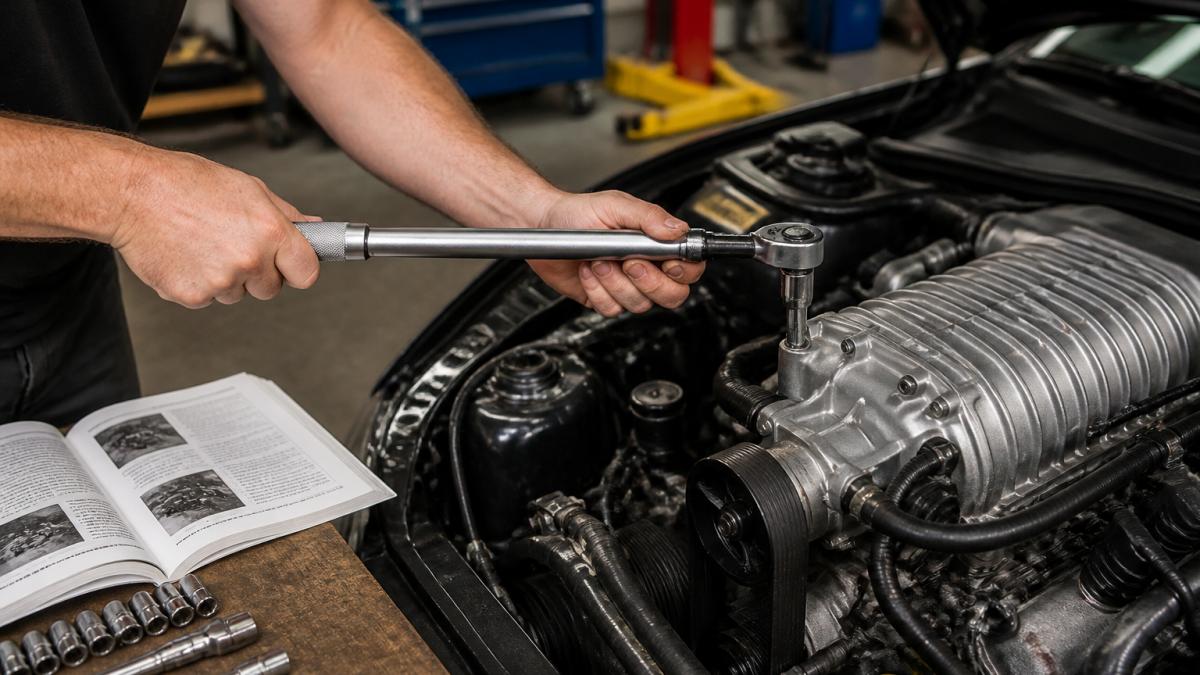
Step 1: Prepare the Vehicle and Disconnect the Battery
Let the car cool completely, then park it on a level surface. Disconnect the negative battery terminal first, then the positive. This prevents any chance of a short while you're working around fuel and electrical connectors.
Drain the coolant into a clean pan. You'll reuse or replace it depending on your kit's requirements. Remove the engine cover, and take photos of the engine bay before you touch anything.
Step 2: Remove Factory Intake and Cooling Components
Pull the airbox, intake tube, and throttle body. On most kits you'll also remove the factory intake manifold and the coolant crossover. Keep every bolt in labeled bags. The intake manifold gaskets usually need replacing, so have new ones ready.
Step 3: Upgrade Fuel System and Install Injectors
This is the step that determines whether your engine survives. Install the larger fuel injectors included with your kit, and upgrade the fuel pump if the kit calls for it. Lubricate the injector O-rings with a drop of clean engine oil before seating them. Push them in straight, never at an angle.
Step 4: Mount the Supercharger Unit
Set the supercharger onto the intake manifold surface with a new gasket. Lower it evenly and start all bolts by hand before tightening any. Follow the manufacturer's torque sequence and spec exactly. Most blowers use a staged pattern, working from the center outward in multiple passes.
Step 5: Install Intercooler Pump and Heat Exchanger
Mount the heat exchanger in front of the radiator, then mount the intercooler pump on its bracket. Connect the coolant lines using the supplied hose clamps. Fill the system and bleed it fully before you start the engine. Air pockets in an air-to-liquid system cause heat soak fast.
Step 6: Route Electrical Harnesses and Vacuum Lines
Route the wiring harness away from heat sources and moving parts. Connect the MAP sensor, throttle body, and any boost reference lines. Reconnect vacuum lines one at a time, matching your photos and labels. A bypass valve that isn't plumbed correctly will cause idle problems.
Step 7: Align Belt Drive and Pulleys
Install the crank pulley and supercharger pulley, then fit the serpentine belt. Check alignment with a straightedge across the pulley faces. Misalignment shreds belts and can damage the blower snout bearing. Spin the engine by hand once to confirm the belt tracks true before you start it.
Mustang Supercharger Tune Requirements
You cannot run a supercharger on a stock calibration. The engine management system needs to know about the extra airflow, or it will run lean and damage pistons.
Most modern kits ship with a calibration tool and a base tune. Our Stage 1 and Stage 2 Whipple kits include a Ford Racing exclusive calibration and a Tomahawk delivery tool for exactly this reason.
2024-26 MUSTANG 5.0L GT AND DARK HORSE SUPERCHARGER →

Datalogging is how you verify the tune is safe. Log manifold absolute pressure, air-fuel ratio, and knock. Send those logs to your tuner and let them refine the calibration. Dyno tuning is the gold standard because it lets the tuner see the whole curve under load.
Mustang Supercharger Installation Time: What to Expect
A professional shop with a lift, the right tools, and experience can complete a full supercharger install in roughly one to two days. That includes the mechanical work, the intercooler plumbing, and a base calibration.
A first-time installer working in a home garage should plan for a full weekend, and possibly longer. The mechanical assembly is the easy part.
Phase |
Shop Time |
DIY Time |
|---|---|---|
Teardown and prep |
3-4 hours |
5-6 hours |
Fuel system and injectors |
2-3 hours |
3-4 hours |
Blower and intercooler install |
4-5 hours |
6-8 hours |
Wiring, vacuum, belt |
2-3 hours |
3-4 hours |
Coolant bleed and first start |
1-2 hours |
2-3 hours |
Tune and datalogging |
2-4 hours |
4-6 hours |
If you're short on time or don't have a lift, this is a job worth handing to a shop. Paul's Automotive Engineering has installed superchargers on Mustangs since 1984, and we're a licensed distributor for Whipple, Procharger, Vortec, and Ford Racing.
Legal and Emissions Compliance for Your Mustang Supercharger
Emissions compliance is the part most install guides skip entirely. If your state runs an inspection program, a supercharger without a CARB Executive Order will fail. Period.
A CARB Executive Order is a number issued by the California Air Resources Board that certifies a part has been tested and approved for use on specific vehicles. Many states adopt CARB standards, so an EO number is your proof of legality in those markets.
Check three things before you buy:
- Does the kit have an EO number for your exact model year?
- Does your state follow CARB or federal EPA standards?
- Will the kit still pass with the tune you plan to run?
The Ford Racing kit we stock carries EO# D-231-129 for 2024-2025 model years, but it's not available in California for the 2026 model year. When in doubt, check the California Air Resources Board aftermarket parts database for the current EO status of any kit.
Post-Install Maintenance Schedule and Drivetrain Compatibility Check
Once the blower is on, the maintenance schedule changes. Forced induction puts more heat and stress on the whole system, so your service intervals tighten up.
Here's the schedule we recommend for a boosted Mustang:
- Every 3,000-5,000 miles: Check intercooler coolant level and top off as needed
- Every oil change: Inspect the serpentine belt for glazing or cracks
- Every 15,000-20,000 miles: Replace the belt and check pulley alignment
- Every 30,000 miles: Service the intercooler pump and flush the coolant loop
- Every 30,000 miles: Replace spark plugs, gapped to the kit's spec
- Annually: Re-torque the blower bolts and inspect all hose clamps
Drivetrain compatibility is the other piece. A blower adds torque everywhere in the curve, and stock parts may not hold. Check your clutch rating on a manual car, and inspect half-shafts, driveshaft, and rear gears. On an F150, the transmission and torque converter are the usual weak points.
Conclusion
Adding boost to a Mustang is one of the most rewarding upgrades you can make, but it's a project that punishes shortcuts. The right kit, the right tune, and the right tools decide whether you end up with a car that pulls hard for years or one that's back in the shop within a month.
That's the difference Paul's Automotive Engineering brings. We stock the 2024-2026 Mustang 5.0L S650 Stage 1 Whipple Supercharger Kit with full 50-state legality, and our team has over 100 years of combined experience installing and tuning forced induction systems.
Email us to schedule your appointment and get your build on the calendar.
Frequently Asked Questions
Can you install a supercharger on a Mustang yourself?
Yes, you can install a Mustang supercharger yourself if you have mechanical experience, a full set of tools, and a safe workspace. However, the job involves removing the intake manifold, upgrading fuel injectors, and routing electrical harnesses. Without proper knowledge, you risk damaging the engine or voiding warranties. Many owners choose professional installation to ensure correct torque specs and tuning.
How long does it take to install a Mustang supercharger?
A typical Mustang supercharger installation takes 8 to 12 hours for a professional shop. If you are working in a home garage, expect 12 to 16 hours or more, especially if you need to bleed the coolant system or troubleshoot fitment. Installation time can vary based on the kit, your Mustang's model year, and whether you are also upgrading fuel injectors or the intercooler pump.
Does installing a supercharger require a tune?
Yes, a custom tune is mandatory. The factory ECU calibration cannot handle the increased airflow and boost pressure, so you need a specialized tune to adjust air-fuel ratio, spark timing, and fuel injector pulse width. Driving without a proper tune risks engine damage. Many supercharger kits include a calibration tool and a pre-loaded tune, but dyno tuning is recommended for maximum safety and performance.
What tools do you need to install a Mustang supercharger?
You'll need a basic mechanic's tool set including sockets, wrenches, and a torque wrench. Specialized tools include a pulley removal tool, a coolant vacuum bleeder, and a serpentine belt tool. Some kits require a fuel line disconnect tool and an OBD-II scanner for datalogging. For belt alignment, a straightedge and feeler gauge are helpful. Always refer to your kit's instructions for any additional tools.

Leave a comment