


Last Updated: November 15, 2026
Quick Summary
Mustang restoration project planning starts by deciding what the car is for, then assessing its condition honestly, especially underneath for rust. Set a line-item budget with low, likely, and high estimates, keep a 15 to 25 percent contingency, and map the work into milestones with buffer time.
- Decide the build goal first, since a show car and a weekend driver need very different budgets and timelines.
- Check floor pans, rocker panels, and strut towers, and use a magnet to find body filler or hidden rust.
- Budget with three tiers per category and use the likely column for planning, not the low one.
- Hold a 15 to 25 percent contingency reserve as a starting point, since hidden rust can consume it alone.
- Outsource safety-critical and specialist tasks like welding, paint, and engine machining, and do disassembly at home.
Table of Contents
- Start With Your Build Goal and Honest Condition Assessment
- How to Choose a Donor Car and Check for Rust Before You Buy
- Build a Mustang Restoration Project Checklist Before Teardown
- Mustang Restoration Cost and Budget: Planning Contingency Ranges
- Mapping a Mustang Restoration Timeline Around Milestones
- Sourcing Mustang Restoration Parts and Verifying Compatibility
- Deciding What to Do Yourself and What to Hand to a Shop
- Booking Your Restoration Consultation With Paul's Automotive Engineering
- Frequently Asked Questions
Start With Your Build Goal and Honest Condition Assessment
Every successful Mustang restoration starts with one question: what is this car actually for? A show-quality survivor and a reliable weekend driver call for very different budgets and timelines, so decide the goal first and then assess the car against it, because solid restoration project planning depends on that choice.
Be honest about condition. Walk around the car with a flashlight, check the floor pans, rocker panels and strut towers, and look under the carpet. Note every problem you find, even the small ones. A written condition list becomes the foundation for every decision that follows.
Watch out: many owners fall in love with a shiny paint job and skip the underbody inspection. Fixing hidden rust later often costs more than the paint did.
How to Choose a Donor Car and Check for Rust Before You Buy
If you are buying a donor car or a project, inspect it in person whenever possible. Bring a magnet and a small flashlight. A magnet that will not stick to rocker panels or quarter panels usually means body filler or rust repair underneath.
Check these areas first:
- Floor pans and trunk floor
- Rocker panels and frame rails
- Strut towers and shock mounts
- Lower fenders and the bottom edges of doors
- Under the battery tray and inside the wheel wells
Ask for the title, service records and any build paperwork. A car with a clean title and documented history usually costs less to restore than one with unknown past repairs.
Build a Mustang Restoration Project Checklist Before Teardown
Before you take anything apart, write a project checklist. It keeps you from losing track of parts and steps months later.
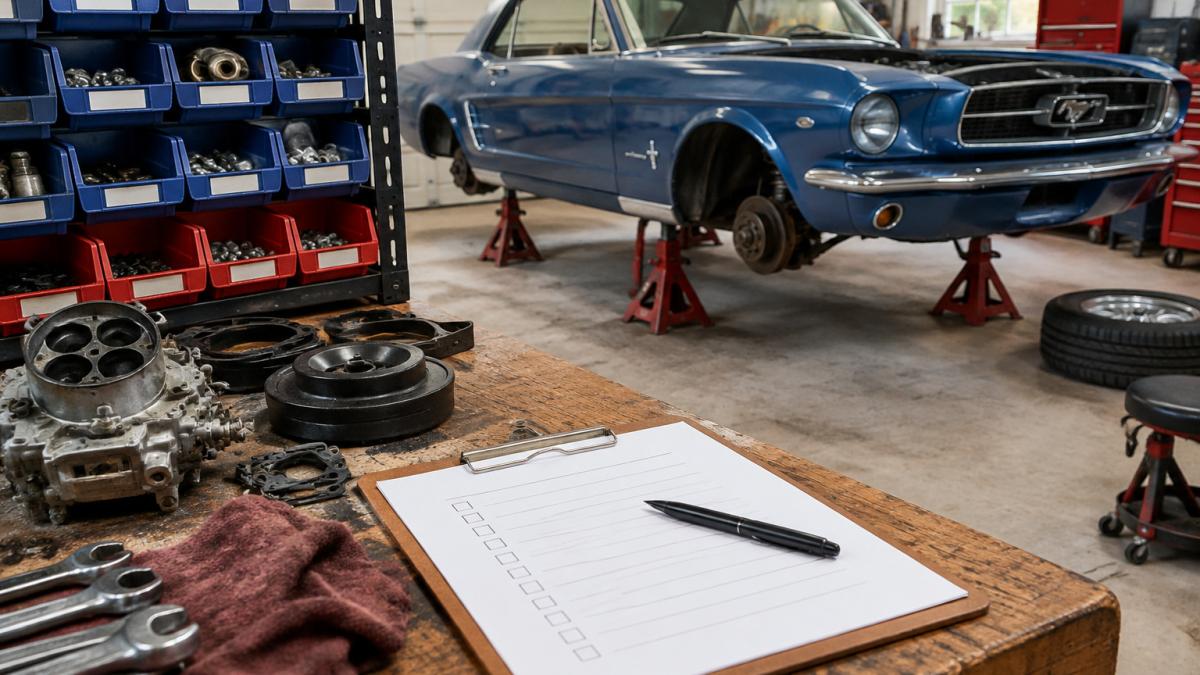
- Photograph the car from every angle before teardown
- Label every bag, bolt and bracket with its location
- Set up a shelf or bin system for each vehicle area
- Keep a running log of parts you need to buy or repair
- Record the work sequence in a shared spreadsheet or notebook
Good documentation is often the difference between a smooth rebuild and a stalled one. Teardown is much easier when you know exactly where each piece goes back.
Mustang Restoration Cost and Budget: Planning Contingency Ranges
Most restoration budgets fail not because the total is wrong but because the money is spent in the wrong order. Build a line-item budget before you buy the first part, and structure it so the car can sit safely at any stage if funds run short.
Start with a three-tier estimate for every category: a low number (you do the work, parts arrive on time), a likely number (some outsourcing, some delays), and a high number (hidden rust, machine-shop surprises, NOS parts). Use the likely column for planning and the high column to decide whether the project is affordable at all.
A workable line-item structure looks like this:
- Purchase price and title/registration fees
- Teardown consumables (bags, labels, penetrating oil, cutoff wheels, storage bins)
- Bodywork and paint, separate materials from labor
- Engine and drivetrain, separate machine work, parts, and assembly
- Suspension, steering, and brakes
- Interior, trim, glass, and weatherstripping
- Wiring and electrical
- Parts shipping, core charges, and return freight
- Contingency reserve
Labor is the line most home restorers underestimate. Body and paint labor is typically billed by the hour, and a full respray with panel work can run into the hundreds of hours. Ask a local shop for its current hourly rate before you budget, and multiply that rate by your own honest hour estimate. If you plan to do the work yourself, still enter a labor line at zero so you can see what the job would cost if you later decide to outsource it.
Stage the spending to match the work sequence. Fund teardown and inspection first, then bodywork and paint, then drivetrain, then assembly and interior. Do not buy interior kits or wheels before the metalwork is finished, those dollars are better held in reserve until the structure is sound.
Watch out: a contingency of 15 to 25 percent is a starting point, not a guarantee. Rust discovered after media blasting, a cracked block, or a transmission that needs a full rebuild can each consume the entire reserve on their own. If the high-column estimate is more than you can absorb, shrink the build goal rather than the reserve. If even the high-column estimate strains the budget, weighing the restoration against the car’s likely payoff can clarify whether to scale back or walk away, a question worth considering with Midnight Motor Club.
Track actual spending weekly against the line items, not monthly against the total. A category that is 40 percent over early is a signal to stop and re-plan before the next parts order ships.
The article breaks the budget into three estimate tiers and a 15 to 25 percent contingency, so the figures below show how each tier is used.
| Estimate tier | What it assumes | How to use it |
|---|---|---|
| Low | You do the work and parts arrive on time | Best-case floor |
| Likely | Some outsourcing and some delays | Use this for planning |
| High | Hidden rust, machine-shop surprises, NOS parts | Decide if the project is affordable |
| Contingency reserve | Covers unexpected costs | 15 to 25 percent starting point |
Mapping a Mustang Restoration Timeline Around Milestones
A restoration timeline is easier to manage when you split it into milestones. Common milestones include: teardown complete, bodywork finished, paint done, drivetrain installed, and final assembly. Set a target date for each one.
Build in buffer time. Parts can take weeks to arrive, and specialist shops often have waiting lists. A realistic timeline gives you room to adjust without derailing the whole project.
Sourcing Mustang Restoration Parts and Verifying Compatibility
Before you order parts, confirm compatibility with your exact model year, engine and trim as part of your restoration project planning. Mustang parts changed significantly across generations, and a part that fits one year may not fit another.
- Match part numbers to your car's VIN and build sheet
- Ask the seller about return policies for incorrect fitment
- Check reviews and buy from sellers who answer technical questions
- Keep receipts and packing slips in your project folder
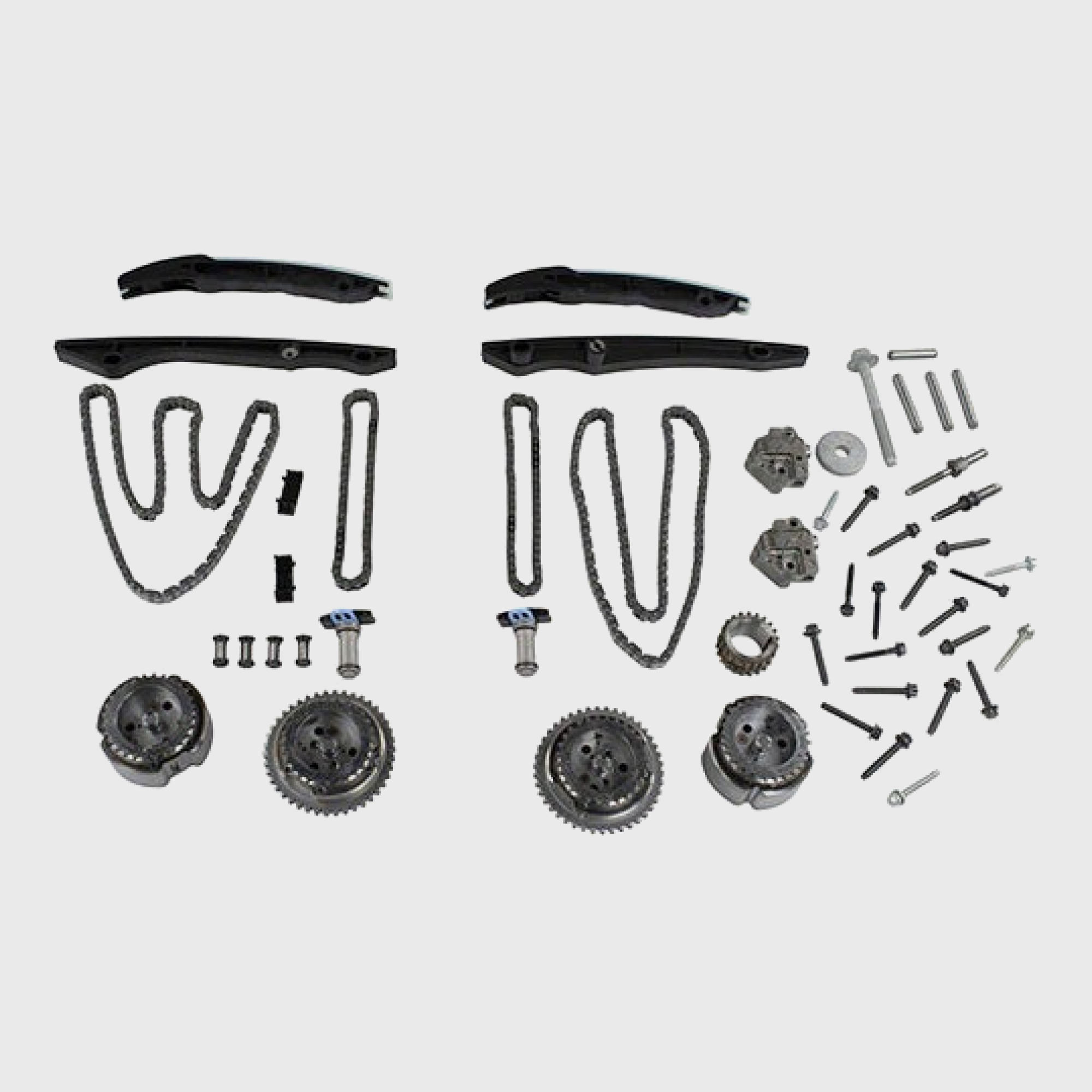
Paul's Automotive Engineering offers Ford performance parts, including the 2011-2014 5.0L 4V TI-VCT Mustang Coyote Camshaft Drive Kit at $604.99. Check the listing's fitment notes against your car before you buy.
Deciding What to Do Yourself and What to Hand to a Shop
Sort every task on your checklist into one of four buckets before the car comes apart: do it yourself, do it yourself with rented tools, outsource to a specialist, or defer until the budget allows. The bucket depends on four factors, your skill, your tools, the safety consequence of a mistake, and the specialist's lead time.
Use this framework task by task:
- Skill: Have you done this exact job successfully before on a similar car? If not, budget for a learning curve or a helper.
- Tools: List the tools the job requires and the cost to buy or rent them. A task that needs a welder, a plasma cutter, a press, or an alignment rack is usually cheaper to outsource than to tool up for one car.
- Safety consequence: Brakes, steering, fuel lines, seatbelts, and structural welding are pass/fail. A cosmetic mistake is repairable; a brake failure is not. When the consequence is safety-critical and your experience is thin, outsource.
- Lead time and cost: Get a written estimate and a scheduled date from the shop before you commit. A specialist with a six-week backlog changes your timeline, not just your budget.
Tasks that usually suit a home garage: disassembly and labeling, cleaning and degreasing, interior removal and installation, trim and weatherstripping, bolt-on suspension replacement, and parts research. These build familiarity with the car and keep momentum without risking the structure.
Tasks that usually belong with a specialist: structural and panel welding, frame straightening, media blasting and primer, paint and bodywork, engine machining and assembly, transmission rebuilds, rear-axle setup, and four-wheel alignment. To learn how to choose a performance shop for your Mustang, read How to Choose a Performance Shop for Your Mustang. These require equipment and repeat experience that most home shops do not have.
Watch out: the most expensive outcome is a task you start, stall on, and then pay a shop to redo. If you are unsure whether you can finish a job, price the outsourced version first and decide with that number in front of you.
Booking Your Restoration Consultation With Paul's Automotive Engineering
Planning a restoration takes time, and a short consultation can save you from expensive mistakes. Paul's Automotive Engineering has specialized in custom Mustang and Ford services since 1984, and our team can review your condition list, budget and goals before you commit to parts or teardown.
Email us to schedule your appointment and get a clear plan for your build.
Frequently Asked Questions
How do you start a Mustang restoration project?
Start by deciding what the finished car should be, whether a period-correct restoration, a restomod with a modern engine, or a driver-quality refresh. Then inspect the car thoroughly for rust, frame damage and missing parts, and photograph everything before disassembly. Write the goal and the inspection findings down, because they drive every later decision on budget, parts and timeline. Many projects stall when owners skip this step and change direction mid-build.
How much does it cost to restore a Mustang?
Cost depends almost entirely on the starting condition and the build goal. A cosmetic refresh costs far less than a full frame-off rebuild with a new engine. Budget for contingency on top of your estimate, since hidden rust and unexpected repairs are common once panels and components come off. Price each major system separately, including bodywork, paint, drivetrain, suspension, brakes and interior, so you can see where the money goes.
Should you restore a Mustang yourself or hire a shop?
Doing the work yourself saves labor costs but takes more time, tools and skill. Consider outsourcing specialist tasks such as precision engine machining and professional paint, while handling disassembly, cataloging and mechanical assembly yourself if you have the space and patience.


