


Quick Summary
A 650 horsepower build on a Ford F-150 is a complete system, not a single bolt-on part, combining forced induction, fuel delivery, cooling, calibration and drivetrain upgrades. Stock Ford engines are the starting point, and a supercharger kit matched to your model year is the main component.
- Crank horsepower and rear-wheel horsepower differ, so confirm which figure a builder quotes.
- The Whipple Stage 2 kit is listed at $9,999.99 for 2021-2023 and $10,299.99 for 2024-2026 trucks.
- Both Whipple kits are rated for 91 octane or higher fuel.
- A 5.0L V8 is the more predictable platform for a 650 horsepower target than a V6.
- Verify your model year before ordering, since kits are engineered for specific year ranges.
Table of Contents
- What a 650 Horsepower F-150 Build Actually Involves
- Choosing the Right F-150 Engine for a 650 Horsepower Target
- Ford F-150 Supercharger Kit Options and Trade-Offs
- Supporting Modifications: Fuel, Cooling, Tuning, and Drivetrain
- Realistic 650 Horsepower F-150 Build Cost Breakdown
- Step-by-Step Build Process and Dyno Validation
- Reliability, Towing, and Warranty Limits After a 650 Horsepower Build
- Booking Your F-150 Build Consultation at Paul's Automotive Engineering
- Frequently Asked Questions
What a 650 Horsepower F-150 Build Actually Involves
Last Updated: November 12, 2026
Getting a stock F-150 to 650 horsepower is not a single bolt-on purchase.
Ford publishes its own figures for the factory powertrains.
Crank horsepower and rear-wheel horsepower are not the same number.
The real work breaks into four areas:
- Airflow: a supercharger or a larger forced-induction system, plus intercooling to keep intake charge temperatures under control
- Fuel: injectors, a high-pressure pump and reliable fuel quality, since 91 octane or higher is typically required for these kits
- Calibration: a tune that manages boost, timing, knock and transmission shift behavior
- Support: cooling, exhaust, and drivetrain components that handle the extra torque
A kit that adds 300 horsepower on paper can still leave you with a lean fuel condition or excessive intake temperatures if the supporting pieces are missing.
Watch out: buying a kit without confirming the tuning platform. A supercharger that arrives without a matched calibration can run poorly or set fault codes, and the truck may spend more time at the shop than on the road.
The sections below walk through engine selection, kit options, supporting modifications, a cost breakdown and the dyno validation process we use before a truck leaves our shop.
Choosing the Right F-150 Engine for a 650 Horsepower Target
The engine you start with determines how much work sits between you and 650 horsepower.
The 5.0L Coyote V8 is the most common platform for supercharged builds. Roush's F-150 program has shown 650 horsepower and 610 lb-ft of torque from a supercharged 5.0L V8, as reported by MotorTrend's Roush F-150 coverage.
Model year matters. Kits are engineered for specific year ranges, and the 2021-2023 and 2024-2026 platforms each have their own fitment, engine bay layout and tuning requirements. Verify your model year before you order anything.
If you are deciding between a V6 and a V8 for this target, consider:
- Starting output: the V8 already produces more torque, so less boost is needed to reach 650 hp
- Heat load: the V6 may need more aggressive cooling to hold boost safely
- Parts availability: V8 forced-induction kits are more widely developed
- Towing: the V8 generally offers a stronger foundation for sustained loads
For most owners pursuing a 650 hp f150 650 horsepower build guide outcome, a 5.0L V8 is the more predictable path.
Our take: if the truck is primarily a daily driver that tows, a well-engineered 600-650 hp setup on a healthy V8 is more livable than chasing peak numbers on a V6.
Ford F-150 Supercharger Kit Options and Trade-Offs
Choosing a supercharger kit is where most of the budget and the reliability decisions are made.
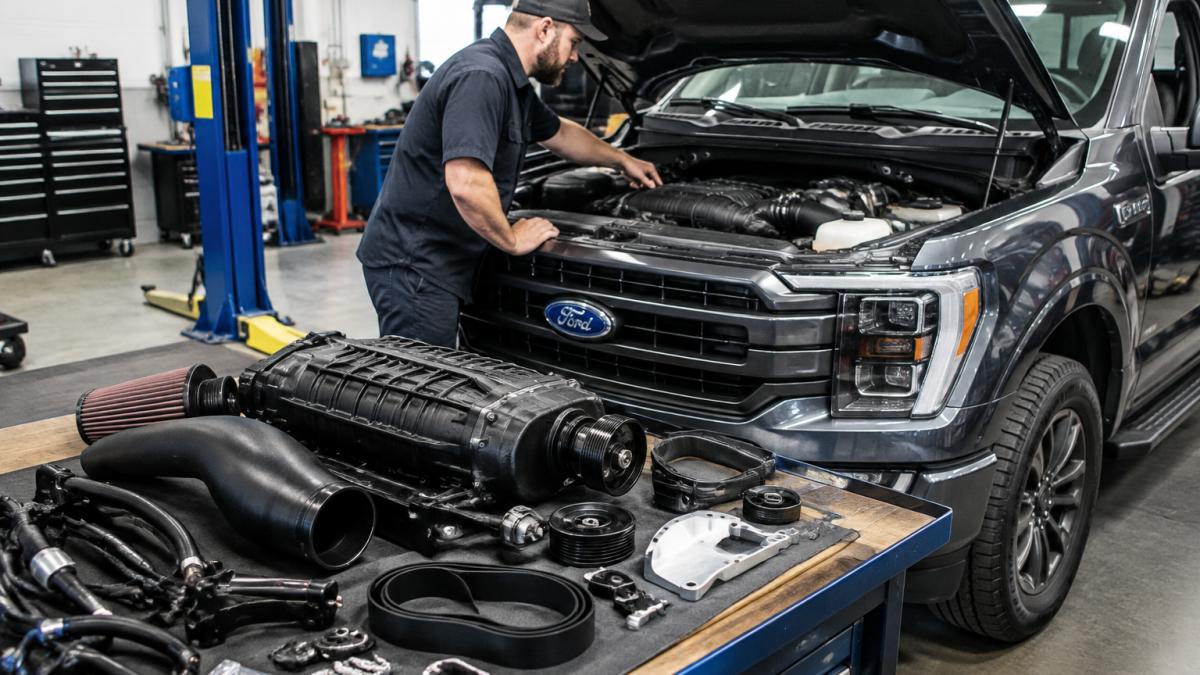
Here is how the two current Whipple options we carry compare:
| Kit | Model Years | Stage | Price (USD) | Best For |
|---|---|---|---|---|
| Ford F150 5.0L Gen 6 Stage 2 SC Kit | 2021-2023 | Stage 2 | $9,999.99 | Owners of 2021-2023 trucks targeting maximum output |
| 2024-2026 Ford F-150 5.0L Gen 6 Stage 2 Whipple Kit | 2024-2026 | Stage 2 | $10,299.99 | Owners of 2024-2026 trucks who want the newest platform fitment |
Both kits are designed to bolt to the factory engine without cutting or grinding, and both are rated for 91 octane or higher fuel. The 2024-2026 kit adds the GT500 Bosch dual-beam fuel injectors and the Tomahawk V2 flash tool, which matters when you plan around calibration.
For owners weighing a phased approach, the Stage 1 to Stage 2 upgrade path is also available for 2021-2026 trucks.
Trade-offs to weigh:
- Stage 1 vs. Stage 2: Stage 2 adds the billet throttle body and fueling upgrades for more airflow and tuning headroom
- Power per dollar: the final output depends as much on the tune and the supporting parts as on the kit itself
- Warranty and emissions: both kits carry 50-state legal status for their listed model years, which affects how they fit with your insurance and registration
We do not recommend choosing a kit on peak horsepower alone. Match the kit to your truck's model year, your fuel access and how the truck will actually be used.
Supporting Modifications: Fuel, Cooling, Tuning, and Drivetrain
A supercharger is only as good as the systems around it.
Fuel system. Forced induction increases fuel demand substantially. The 2024-2026 Stage 2 kit includes upgraded injectors, but many builders also address the high-pressure pump and fuel quality.
Cooling. Heat is the constraint that limits how long you can hold boost. The Whipple Gen 6 uses a dual-pass, dual-core intercooler design with an oversized heat exchanger and high-flow pump.
Tuning. The calibration is the piece that ties everything together. A proper tune manages boost, ignition timing, knock response and transmission shift behavior.
Drivetrain. At 650 horsepower, the stock driveline is under real stress. Clutch or torque converter capacity, axle strength and transmission cooling all deserve attention, especially if the truck tows.
Exhaust and intake upgrades also appear in many builds. They can help airflow, but they are not a substitute for the items above.
Realistic 650 Horsepower F-150 Build Cost Breakdown
Costs depend heavily on the kit you choose, the labor required and how much supporting work the truck needs. The figures below reflect Paul's Automotive Engineering's own listed prices where we have them. Labor, tuning and dyno time are quoted separately based on the scope of the build, so we do not publish a single installed price for every truck.
| Line Item | Cost (USD) | Notes |
|---|---|---|
| Whipple Stage 2 SC kit, 2021-2023 | $9,999.99 | Listed price |
| Whipple Stage 2 SC kit, 2024-2026 | $10,299.99 | Listed price |
| Installation labor | Quoted per vehicle | Depends on model year and added parts |
| Tuning and calibration | Quoted per vehicle | Included in build scope discussion |
| Supporting parts (fuel, cooling, drivetrain) | Varies | Determined by vehicle inspection |
| Dyno validation | Quoted per vehicle | Confirms rated output |
The supercharger kit is typically the largest single expense, but it is not the whole picture. Owners who plan only for the kit often find that cooling, fuel and drivetrain work adds meaningful cost. Budget for those systems from the start rather than discovering them mid-build.
Because supporting-part costs vary by truck, requesting a written scope before ordering can help you plan the build.
Step-by-Step Build Process and Dyno Validation
A 650 hp build follows a predictable sequence. Skipping steps is where problems start.
- Inspect the truck. Confirm model year, engine health, compression and any existing modifications. A truck with worn internals should be addressed before boost is added.
- Specify the kit and supporting parts. Match the supercharger to the platform and add the fuel, cooling and drivetrain items the truck requires.
- Install the system. Mechanical installation includes the supercharger, intercooler, throttle body and fueling components. Expect this to take the bulk of the shop time.
- Flash the calibration. The tune is installed and matched to the hardware. Initial maps are conservative so the engine can be checked before boost is raised.
- Dyno validation. The truck is run on a chassis dyno to measure rear-wheel output, check air-fuel ratios and confirm boost and timing behave as designed. Heat and knock are monitored throughout.
- Road test and final tune. Real-world driving reveals issues a dyno pull can miss, so the calibration is refined afterward.
A chassis dyno reports rear-wheel horsepower, which is the number that matters on the road. Ask for that figure and compare it to any crank number quoted by a builder.
Watch out: never accept a tune that has not been validated under load. A calibration that looks fine at idle can run lean or knock at full boost.
Reliability, Towing, and Warranty Limits After a 650 Horsepower Build
A 650 hp truck can be driven daily, but it operates with less margin than a stock truck. Heat management and fuel quality are the two factors that most affect long-term reliability.
Towing is where the ratings matter most.
Warranty coverage can change after modification. Ford's powertrain warranty and any performance parts coverage are separate matters, and your dealer or insurer can confirm how a supercharged build affects your policy. Keep documentation of every part installed and every calibration applied.
Our take: power is the easy part. A 650 hp truck is only a good build if it can tow, stop and run reliably for years.
Booking Your F-150 Build Consultation at Paul's Automotive Engineering
If you are planning a 650 hp build and want the scope, parts and cost laid out for your specific truck, book a build consultation with Paul's Automotive Engineering and we will walk through the options against your model year and how you use the truck. For towing-focused upgrades, see our F150 performance upgrades that actually help with towing. If you are deciding whether to install a kit yourself, read our guide on whether a supercharger kit is a DIY job before you commit.
Paul's Automotive Engineering specializes in custom Ford services and performance upgrades. Email us to schedule your appointment, and we will confirm your truck's fitment, the supporting parts it needs and a realistic timeline before anything is ordered.
Frequently Asked Questions
How much does it cost to build a 650-horsepower F-150?
A 650 horsepower F-150 build typically combines a supercharger kit, supporting fuel, cooling, and tuning upgrades, plus professional installation. Paul's Automotive Engineering lists the Ford F-150 5.0L Gen 6 Stage 2 SC Kit for 2021-2023 at $9,999.99 and the 2024-2026 Ford F-150 5.0L Gen 6 Stage 2 Whipple Supercharger Kit at $10,299.99. Those figures cover the kit only. Installation and supporting parts are quoted separately, so request a written quote before committing.
Can a stock F-150 engine handle 650 horsepower?
A stock F-150 engine is not designed to hold 650 horsepower reliably over the long term. Reaching that output requires forced induction, upgraded fuel delivery, and calibrated engine management to keep cylinder pressures and temperatures within safe limits. Supporting modifications and disciplined tuning reduce the risk of internal damage, but no build removes it entirely.
Is a supercharger or turbocharger better for a 650-horsepower F-150?
Superchargers deliver boost immediately because they are driven mechanically from the engine, which makes them a practical choice for street driving and towing. Turbochargers can be efficient at high output but usually require more plumbing and a different tuning approach. For a 5.0L Coyote-based F-150 with a bolt-on kit, a supercharger system is the more direct path, and the Whipple Gen 6 Stage 2 kits are designed for that application.
What supporting modifications does a supercharged F-150 need?
A supercharged F-150 generally needs higher-octane fuel, fuel system upgrades to supply the extra airflow, an intercooler system that keeps intake temperatures under control, and a calibrated engine management tune. Drivetrain and cooling upgrades are also worth budgeting for. The Whipple Stage 2 kits include a high-flow pump and an oversized heat exchanger, and the systems are tuned for 91 or higher octane fuel.
Can a 650-horsepower F-150 still tow safely?
A 650 horsepower F-150 can still tow, but towing capacity is set by the truck's rated limits, not its power output. Towing capacity depends on the factory rating for your specific configuration, which should be confirmed with Ford's official specifications. Added power does not raise those ratings, and heavy towing puts extra heat and stress on the engine and drivetrain, so monitor temperatures closely.
What fuel and tuning does a 650-horsepower F-150 require?
A 650 horsepower F-150 needs premium fuel, typically 91 octane or higher, along with a calibrated tune that adjusts spark timing, boost, and fuel delivery to the new airflow. The Whipple Stage 2 kits include the Tomahawk V2 flash tool for PCM programming. Tuning should be adjusted for the specific fuel available in your area.
Which F-150 engine is best for a 650-horsepower build?
The 5.0L Coyote V8 is the most common base for a 650 horsepower F-150 build because it responds well to supercharging and is supported by bolt-on kits. Paul's Automotive Engineering offers Whipple Stage 2 kits for 2021-2023 and 2024-2026 trucks with this engine, which are rated up to 775 horsepower to the flywheel in the 2021-2023 configuration. Rated crank horsepower and rear-wheel horsepower differ, so compare dyno results on the same basis.


