


Last Updated: November 2, 2026
Quick Summary
To safely tune F150 horsepower, start with a physical pre-tune inspection covering compression, leak-down, spark plugs, fluids, cooling, and fuel system health, then fix any failures before touching the ECU. Record a baseline horsepower and torque, choose a calibration matched to your engine, and validate it with data logs.
- A compression and leak-down test confirms rings and valves seal before any calibration touches the ECU.
- The 2.7L EcoBoost calibration is 49-state approved and requires premium fuel.
- The 3.5L performance calibration is 50-state approved and includes a ProCal 4 tool.
- On the 5.0L Coyote, airflow upgrades like a cold air intake and intake manifold free up power.
- Stop testing and revert to stock if you see repeated knock retard or fuel trims beyond 10 percent.
Table of Contents
- Step 1: Inspect the Truck Before You Tune F150 Horsepower
- Step 2: Know Your Baseline Horsepower and Torque
- Step 3: Pick the Right Path for F-150 EcoBoost Tuning
- Step 4: Plan the F-150 5.0 Coyote Tune Around Airflow and Fuel
- F-150 Custom Tune vs Canned Tune: Which Is Safer?
- F-150 Tuning for Towing: Making Power Without Melting the Transmission
- Step 5: Validate the Calibration and Watch for Warning Signs
- Book a Dyno Session and Pre-Tune Inspection at Paul's Automotive Engineering
- Frequently Asked Questions
Step 1: Inspect the Truck Before You Tune F150 Horsepower
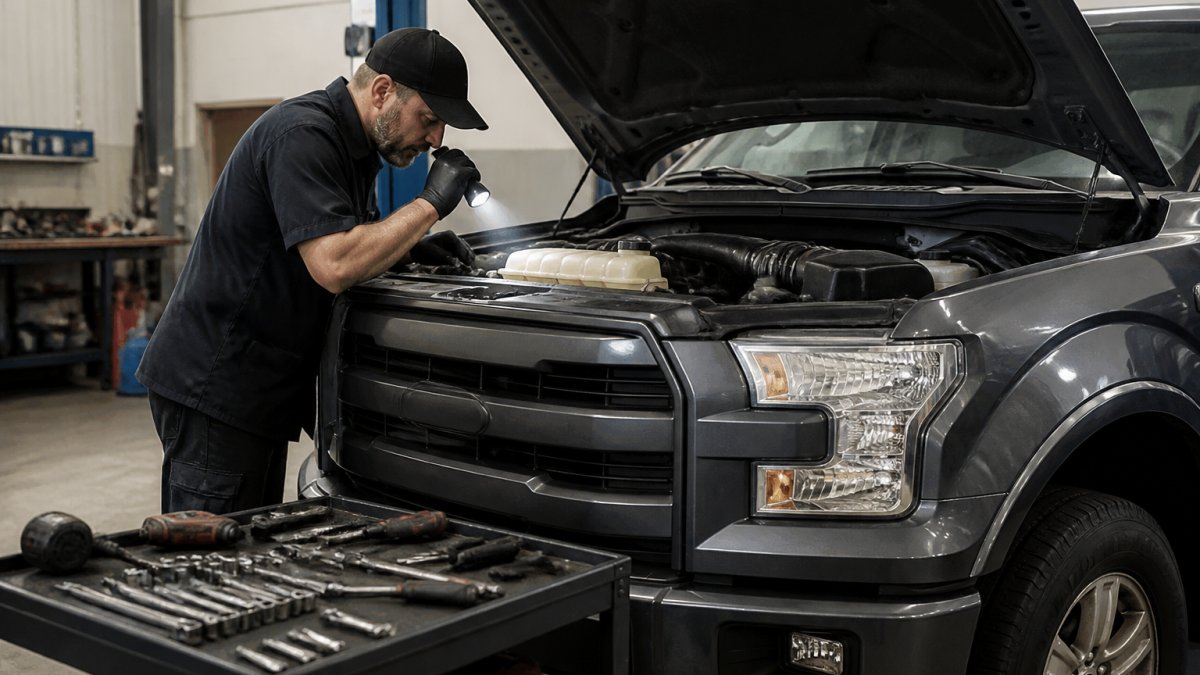
Here's the hard truth most tuning guides skip: the engine that fails after a tune was usually already sick before the tune. To safely tune F150 horsepower, you start with a physical inspection, not a laptop. At Paul's Automotive Engineering, we've spent over four decades building Ford performance vehicles, and a pre-tune check is where problems that would otherwise turn a modest power bump into a cracked piston get caught.
Compression, Leak-Down, and Spark Plug Checks
A compression test tells you whether the rings and valves still seal. A leak-down test tells you where they leak. Run both before any calibration touches the ECU. Pull the spark plugs and read them: oil fouling, heavy wear, or the wrong heat range all signal a motor that needs service first.
What separates a real inspection from a quick look is a pass/fail standard. If any of these checks fail, the tune waits until the mechanical issue is fixed.
Fluids, Cooling, and Fuel System Health
Fresh oil, a healthy cooling system, and clean fuel delivery are non-negotiable. Boost raises cylinder pressure and heat, so a weak water pump or clogged injector becomes a failure point fast. If you're not sure who should do this inspection, our guide on how to find a trusted F150 performance shop near me walks through the questions to ask.
Go deeper than a visual check.
Model-Specific Pre-Tune Checks
The inspection is not one-size-fits-all. On the 5.0L Coyote, pay attention to cam phaser noise and oil consumption history, since timing and airflow changes put more demand on the variable cam system. On the 3.5L EcoBoost, inspect the turbochargers for shaft play and check for carbon buildup on the intake valves, a common pattern on direct-injection engines. On the 2.7L EcoBoost, confirm the truck is running the correct calibration for its model year before assuming a Ford Performance calibration will apply. Drivetrain matters too: a 10R80 transmission with deferred fluid service should get a fluid and filter change before it sees added torque.
Step 2: Know Your Baseline Horsepower and Torque
You cannot measure a gain you never recorded.
Data logging during that baseline run matters just as much.
Step 3: Pick the Right Path for F-150 EcoBoost Tuning
EcoBoost tuning is mostly about boost, fuel, and heat management, and the right calibration depends on your engine and model year. Ford Performance's dyno-tested calibrations are a smart starting point because they keep reliability in the design brief. For 2021-2023 2.7L trucks, the 2.7L EcoBoost performance calibration is a 49-state approved option that requires premium fuel. Owners of the 3.5L have a matching 3.5L performance calibration, which is 50-state approved and includes a ProCal 4 tool that can read and clear diagnostic codes.


Watch out: premium fuel is not a suggestion with these calibrations. Running lower octane under boost invites knock, and the ECU will pull timing to protect itself, which erases the gain you paid for.
Step 4: Plan the F-150 5.0 Coyote Tune Around Airflow and Fuel
The 5.0L V8 responds differently. It's naturally aspirated, so airflow is the whole game: a cold air intake, an upgraded intake manifold, and a larger throttle body free up power the factory left on the table. From there, a calibration adjusts timing and air-fuel ratio to match the extra air.
2021-2023 F-150 2.7L ECOBOOST PERFORMANCE CALIBRATION M-9603-F27 →
For owners chasing serious numbers, forced induction changes the math. A supercharger kit paired with the right power module and a careful tune is how a Coyote makes big power without detonation. The 5.0L Coyote power module for the 10R80 is built for exactly that path.
F-150 Custom Tune vs Canned Tune: Which Is Safer?
A canned tune is a pre-built calibration made for a stock or near-stock truck. A custom tune is written and data-logged for your specific engine, fuel, and modifications. Neither is automatically safer. A canned tune from a reputable source is conservative and repeatable. A custom tune can extract more, but only if the tuner validates it with logs.
If you're weighing forced induction, compare the options before you commit. What most guides miss: the tune matters more than the hardware. A great blower with a lazy calibration runs worse than a mild setup dialed in properly.
| Path | Best For | Fuel | Validation Needed |
|---|---|---|---|
| Ford Performance calibration | Stock EcoBoost, reliability-first | Premium | Minimal, plug and play |
| Custom dyno tune | Modified trucks, max safe output | Premium | Full data logging |
| Supercharger + calibration | 5.0L big-power builds | Premium | Dyno plus street logs |
F-150 Tuning for Towing: Making Power Without Melting the Transmission
Towing puts load on the engine and heat in the transmission, so F-150 tuning for towing is a different job than chasing peak numbers. Shift points and torque converter behavior matter as much as horsepower. A calibration that raises torque but ignores shift strategy can cook a 10R80 on a long grade. Maintaining long-term engine health requires balancing these aggressive power gains with rigorous dyno tuning safety to ensure your truck remains reliable under sustained heavy loads.
Step 5: Validate the Calibration and Watch for Warning Signs
Every tune needs validation. After flashing a calibration, log a series of pulls and check knock, timing, air-fuel ratio, and boost against your baseline. If the numbers don't line up, stop and diagnose before you drive hard.
How to Evaluate a Tuner and Validate a Calibration
A calibration is only as good as the process behind it.
Warning Signs to Respect
- Audible knock or pinging under load
- Rising coolant or oil temperatures
- Check engine light or stored codes
- Hesitation, misfires, or rough idle
- Boost creeping past the calibration's target
- Transmission shudder or delayed shifts under load, which can signal a 10R80 calibration that needs shift-pressure adjustment
Patience here saves engines. A calibration is a starting point, not a finish line, and the data tells you whether it's working.
Book a Dyno Session and Pre-Tune Inspection at Paul's Automotive Engineering
The safest tune is the one backed by a real inspection and a real baseline. If you want your F-150 dialed in, our Blue Ash shop can help. We're a licensed distributor for Whipple and Ford Racing, with over 100 years of combined experience across our team.
Email us to schedule your appointment and we'll walk you through every step, so you know exactly what's happening under the hood.
Frequently Asked Questions
How much horsepower can a tune add to an F-150?
Gains depend on the engine. Ford Performance's calibration for the 2021-2023 F-150 3.5L EcoBoost raises peak output to 450 hp at 5,250 rpm and 510 lb-ft of torque at 3,500 rpm, a gain of 55 hp and 100 lb-ft over stock. The 2.7L EcoBoost calibration peaks at 355 hp and 433 lb-ft. A supercharger kit like the Whipple Stage 2 for the 5.0L V8 is a much bigger step, rated at 775 hp and 675 lb-ft to the flywheel. Always start with a dyno baseline so you know what your truck actually makes before the tune.
Can tuning an F-150 damage the engine or transmission?
A calibration from a reputable source, installed on a healthy engine, is designed to stay within safe limits. Damage usually comes from skipping the pre-tune inspection, running too much boost on stock fuel and cooling, or ignoring knock and high intake temperatures. Ford Performance calibrations are dyno tested and carry a 3-year/36,000-mile warranty from the new vehicle in-service date when installed by a Ford dealer or an ASE-certified technician. Watch for check-engine lights, audible knock, and rising transmission temperatures as early warning signs.
Does an F-150 need premium fuel after a tune?
Yes, in most cases. The Ford Performance calibrations for the 2.7L and 3.5L EcoBoost and the Raptor all require premium fuel, with the 3.5L and Raptor calibrations specifying 91 octane minimum. The Whipple Stage 2 supercharger kit for the 5.0L is also designed for 91 octane or higher. Lower octane increases the risk of knock, and the ECU will pull timing to protect the engine, which erases much of the gain you paid for. Budget for premium fuel as part of the tune, not as an optional extra.
Is a custom tune better than an off-the-shelf F-150 tune?
They solve different problems. An off-the-shelf calibration such as the Ford Performance M-9603-F35 is validated, emissions compliant in 50 states, and backed by a warranty when installed by a qualified technician, which makes it the safer starting point for a mostly stock truck. A custom tune is worth the money once you add airflow parts, change tire size or gearing, tow heavy loads, or want the calibration matched to your exact fuel and elevation. Either way, ask for data logs and a dyno pull so the result is measured, not assumed.


