


Table of Contents
- Start With What Your Mustang Needs to Do
- Check Mustang-Specific Experience Before Anything Else
- Read Mustang Performance Shop Reviews the Right Way
- Evaluate Dyno Tuning Capability and Calibration Process
- Understand Supercharger and Engine Upgrade Installation Scope
- Set Communication Expectations Before Authorizing Work
- Book Your Mustang Consultation With Paul's Automotive Engineering
- Frequently Asked Questions
Start With What Your Mustang Needs to Do
Last Updated: November 5, 2026
Choosing a performance shop for your Mustang starts with one question: what is the car actually for? A clear answer helps you narrow your search for a performance shop that fits your specific build. A Mustang GT that sees weekend track days needs a different build than one that commutes on Interstate 75 and goes to car shows on Saturdays. The right shop depends on that answer.
Decide the goal first, then pick the shop.
Start with three questions:
- How often will it be driven hard? Daily driving, weekend fun, drag strip, or road course use each call for different calibration and cooling.
- What is the budget ceiling? Set a realistic number before shopping. Installation labor, tuning, and parts can all change the total.
- Is it street-legal? Some modifications affect emissions compliance and inspection status (the EPA). Know which rules apply where you register the car, and ask the shop how they handle that.
Watch out: Ordering a kit online before talking to an installer can create compatibility problems. Confirm that the parts you plan to buy work with the shop's install and tuning process.
Check Mustang-Specific Experience Before Anything Else
Not every performance shop works on Mustangs regularly. A general engine or drivetrain shop may be skilled, but Ford's platforms have their own quirks in wiring, cooling, and engine management.
When you vet a performance shop Mustang specialists run, ask them directly:
- How many Mustangs of this generation have you installed this kind of upgrade on?
- Which years and engine types have you worked on?
- Can you show me examples of finished work on similar cars?
Shops that answer these questions quickly and specifically are usually the ones that have done the work. Vague answers are a warning sign.
Mustang-specific experience matters most for forced induction and engine swaps. Classic Mustang owners looking at a modern engine swap should also ask about fabrication and wiring work outside the bolt-on scope.
Read Mustang Performance Shop Reviews the Right Way
Online reviews can help, but most owners read them passively. To actually choose between shops, treat reviews as evidence to be cross-checked, not as a star rating to be trusted. The goal is to answer one question: has this shop done work like mine, on a car like mine, and did the owner stay happy after the honeymoon period?
Start by sorting reviews into three buckets:
- Specific work reviews. Look for mentions of a named job, a supercharger install, a dyno tune, a clutch replacement, a header install, rather than "great service" or "fast turnaround." Specificity is hard to fake and easy to verify against the shop's own build posts.
- Process reviews. These describe how the shop communicated: whether estimates were honored, whether the owner was called when the car was on the lift, whether delays were explained before the owner had to ask. Process reviews predict your experience better than outcome reviews.
- Long-term reviews. Search for updates posted months or a year after the work. A review written the day of pickup tells you about the handoff; a review written after 10,000 miles tells you about the build.
Then run a simple cross-check. Pull the shop's name plus the specific platform and job into a search engine and into the owner forums for that generation. Build threads are the closest thing to an audit trail: they show the parts that were actually installed, the dyno sheet, the problems that came up, and how the shop handled them. A shop with a handful of detailed build threads is usually a stronger signal than a shop with hundreds of one-line five-star reviews.
Watch out: Be cautious of review profiles where nearly every review is short, undated, and mentions price or speed but no specific work, that pattern is common on purchased or incentivized review pages and tells you little about capability.
Finally, read the negative reviews for response quality, not just for the complaint. A shop that replies with specifics, what happened, what was done to make it right, is demonstrating the communication you want when something goes sideways on your own build. A shop that argues publicly or ignores complaints is showing you its post-install posture in advance.
If you want a structured way to compare what you find, keep a simple scorecard with one row per shop and columns for: number of specific Mustang build examples, presence of long-term follow-up reviews, forum build threads, and quality of responses to complaints. Two or three shops scored this way will separate quickly.
Evaluate Dyno Tuning Capability and Calibration Process
Tuning is where many performance builds succeed or fail. A supercharger or engine kit can add significant power, but the calibration determines whether the engine runs safely and reliably.
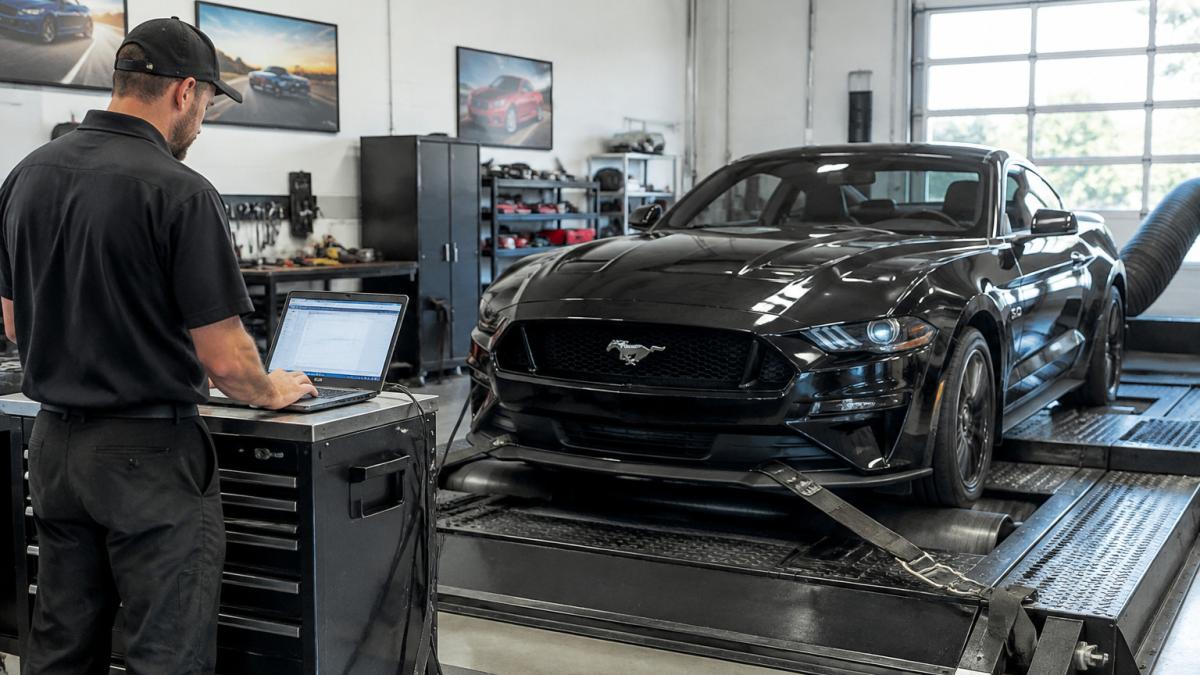
Ask whether the shop has in-house dyno capability and how they calibrate after installation. For a closer look at what dyno tuning actually delivers, read Mustang GT Dyno Tuning Benefits: What You Really Gain. A good process typically includes:
| Step | What to Confirm | Why It Matters |
|---|---|---|
| Pre-tune baseline | Stock or current dyno numbers recorded | Shows real gains, not estimates |
| Calibration | Fuel and timing set for the new hardware | Prevents lean or knock conditions |
| Validation pull | Repeat runs at temperature | Confirms stability |
| Final documentation | Printed or digital dyno sheet | Gives you a record to compare later |
Ask to see a sample dyno sheet. You can compare a complete Mustang GT calibration package with cold air intake and throttle body against what a shop offers. Look at air-fuel ratio and timing data, not just peak horsepower. Be wary of any shop that promises a specific horsepower number before seeing your car.
Pricing for tuning and dyno time depends on the job. Ask for a written quote that lists tuning separately from installation, and contact Paul's Automotive Engineering directly for current pricing.
Email to schedule your appointment →
Understand Supercharger and Engine Upgrade Installation Scope
Installation scope is the part of the quote that most often surprises owners, and it is also where two shops can quote the same job and mean very different things. A useful way to compare is to break every quote into four layers and confirm which layers are included in writing.
Layer 1: Parts. Confirm whether the quote lists parts at all, or only labor. Ask whether the parts are the shop's preferred kit or a kit you supply, and who handles a missing or wrong part. If you supply parts, understand that most shops will not warranty the part itself and may charge diagnostic time if a supplied part fails.
Layer 2: Supporting hardware. A supercharger or engine kit at a given power level usually needs supporting work, fuel system capacity, cooling, spark plugs and gap, sometimes a catch can or upgraded fasteners. Our guide on choosing the right Mustang supercharger for your build walks through how to match hardware to your goals. Ask the shop to state, in the quote, which supporting items are required for the power level you want and which are optional. This is where a low labor quote often hides cost.
Layer 3: Calibration and validation. Confirm whether tuning is included, whether it is a canned tune or a custom dyno calibration, and whether the quote includes a baseline pull, validation pulls, and a printed or digital dyno sheet. A quote that separates installation from tuning is not automatically worse, but you need both numbers before you compare. The same habit of comparing workmanship and documented results applies when evaluating reliable custom wheel builders, where fitment and finish deserve scrutiny alongside the quote.
Layer 4: Post-install support. Ask what happens after you drive away: how many follow-up datalogs or reflashes are included, what the shop's policy is on a check-engine light in the first 30 days, and whether a re-tune is included if you add a part later. Get the answer in writing.
With those four layers defined, build a comparison sheet. For each shop, record: total quoted price, what is explicitly excluded, tuning method, number of included revisions, warranty terms on labor and on parts, and expected completion date. The lowest total is rarely the lowest cost once exclusions are added back in.
Watch out: A quote that lists labor only, with tuning and fuel system work "to be determined after inspection," is not a comparable number, ask for a worst-case estimate in writing before you authorize anything.
On warranty, separate three things: the parts manufacturer's warranty, the shop's labor warranty, and any calibration warranty. Many parts warranties are voided or narrowed by certain tuning approaches, and some shops will not warranty labor on a build they did not calibrate. Ask each shop to explain, in plain terms, what is covered if the engine fails after the install and what documentation they require to honor a claim.
Finally, ask how the shop handles post-install troubleshooting. A good answer describes a process: datalog review, a scheduled follow-up, a defined path for a drivability issue, and a clear point of contact. A vague answer, "bring it back and we'll look at it", is a signal that follow-up is informal. For a forced-induction or engine build, the follow-up process matters as much as the install itself.
Set Communication Expectations Before Authorizing Work
Clear communication separates a good shop experience from a frustrating one. For more on what to expect, see Mustang Performance Shop Communication: What to Expect. Settle these points before any work begins:
- Who your main contact is and how they prefer to be reached
- How often you'll get updates during the build, such as at each milestone
- How the shop handles delays, especially parts backorders
- Who approves changes if the shop finds something unexpected
Get the timeline in writing. Ask how long parts typically take to arrive and what happens if they're delayed. Performance parts can take time to ship, and a shop that plans for delays will set realistic expectations up front.
If you're shipping the car in from out of state, confirm how drop-off, pickup, and any problems after the install will be handled.
Book Your Mustang Consultation With Paul's Automotive Engineering
If you're weighing a performance upgrade for your Mustang, the next step is a direct conversation about your goals, your budget, and the work involved. Paul's Automotive Engineering works on Mustangs and Ford vehicles, with a focus on supercharger installation, engine upgrades, and performance upgrades.
To schedule your appointment, email the shop with your Mustang's year, engine, and the upgrade you're considering. Include a short description of how you plan to use the car so the team can recommend a practical scope.
Frequently Asked Questions
How do I choose a performance shop for my Mustang?
Start by matching the shop to your goal: street performance, track use, or a full build. Confirm the shop has worked on your specific Mustang generation, ask for examples of similar builds, and check whether they perform in-house dyno tuning. Compare written estimates line by line, and make sure the shop explains how parts, labor, and tuning are billed before you authorize work. Clear answers to these questions usually predict a smooth project.
What should I ask a Mustang performance shop before starting a build?
Ask who will do the installation and how long they have worked on Mustangs. Ask which parts they recommend and whether those parts are compatible with your model year and your intended use. Ask how the tune will be performed and calibrated, what the warranty covers on parts and labor, and how you will be updated during the build. Ask for a written estimate that lists parts, labor, and tuning separately.
What should a Mustang performance shop include in a written estimate?
A solid estimate lists each part with its manufacturer and part number, labor hours or a flat-rate labor charge, dyno and tuning time, shop supplies, and any fluids or consumables. It should also note what is excluded, such as diagnostics for unrelated issues, and state the warranty terms. Pricing depends on the parts you choose, the scope of the build, and the schedule. For current pricing or a quote, contact Paul's Automotive Engineering directly.
How long does a Mustang performance upgrade usually take?
Timelines vary widely. A bolt-on install with a short tune may take a few days once parts arrive, while a supercharger or engine build can take longer because of parts lead times, fabrication, and dyno scheduling. Ask the shop for a realistic schedule that accounts for shipping delays, and request regular status updates so you know where the project stands at each stage.


