


Quick Summary
A mustang restoration shop should offer complete or frame-off restorations, mechanical builds and bodywork, and you should confirm which services it performs in-house. Ask for a written scope, a milestone schedule and a broken-out estimate before committing. Compare shops on the same scope rather than on headline totals.
- Frame-off work removes the body so hidden floor pan and frame rust can be inspected and repaired.
- Rust repair, engine and drivetrain work, and paint quality are the biggest cost drivers.
- Owners should budget a contingency, since teardown often reveals hidden condition problems.
- Milestone-based payments tied to completed, inspectable work protect you better than large upfront deposits.
- Get a written scope, change-order process and warranty terms before any work starts.
Table of Contents
- What Custom Mustang Restoration Shop Services Actually Include
- Step-by-Step: How a Restoration Project Moves From Teardown to Handover
- Budgets and Cost Drivers for a Custom Mustang Build
- Classic Mustang Modern Engine Swap: Preservation Versus Modification
- Sourcing Mustang Restoration Parts Without Losing Time
- How a 66 Mustang Restoration Differs From Later Models
- Vetting a Mustang Restoration Shop Near Me Before You Commit
- Frequently Asked Questions
What Custom Mustang Restoration Shop Services Actually Include
Custom Mustang restoration shop services cover far more than a fresh coat of paint. Most shops split their work into complete restorations, mechanical builds and bodywork, and many run all three under one roof.
Restoration providers often advertise a wide service range. That breadth is useful, but it also means you should ask which of those services a shop performs in-house and which it subcontracts.
Complete and frame-off restorations
A complete restoration takes the car down to its core. Frame-off work removes the body from the chassis so the frame, floor pans and mounting points can be inspected, repaired or replaced.
Ask the shop how much of the car it disassembles and whether it documents each part. Strong shops photograph and tag components during teardown, which makes reassembly and any future factory-correct research much easier.
Engine, drivetrain and mechanical work
Mechanical work covers everything from a stock engine rebuild to a modern transmission swap. Ask whether the shop you are considering can keep the original driveline for a numbers-matching car or upgrade it for daily driving, and how it handles tuning for the final configuration.
WATCH OUT: Mixing a modern drivetrain into a classic chassis changes the load on brakes, axles and mounts. Confirm that the shop plans for those changes rather than treating the swap as a simple bolt-in.
Step-by-Step: How a Restoration Project Moves From Teardown to Handover
A restoration project follows a predictable sequence, even though every car throws up its own surprises. The stages below describe what a well-run shop typically does, so you can check whether a quote reflects the full job.
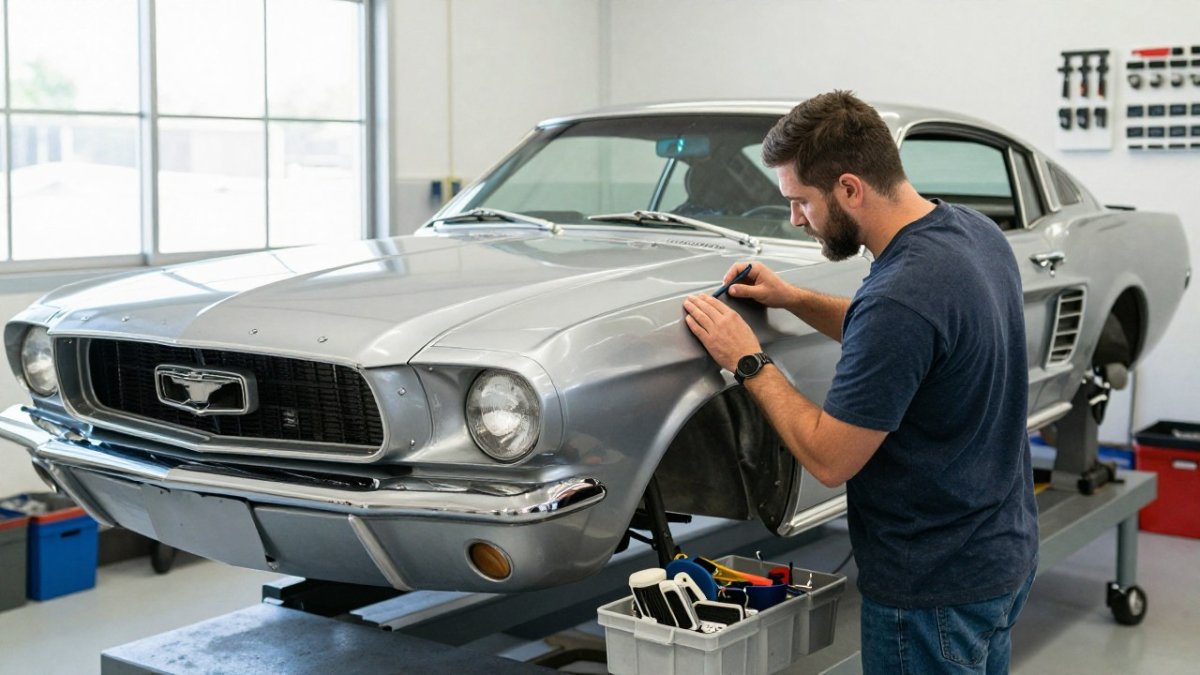
- Assessment and quote. The shop inspects the car, documents its condition and agrees on a scope in writing.
- Teardown and cataloging. Parts come off in labeled groups, and each component is logged.
- Metalwork and rust repair. Floors, rockers and body mounts are cut out and replaced where needed.
- Bodywork and paint preparation. Panels are straightened, gapped and primed.
- Mechanical rebuild. The engine, drivetrain, brakes and suspension are rebuilt or upgraded.
- Interior and trim. Upholstery, carpet, chrome and glass are restored or sourced.
- Reassembly, testing and handover. The car is put back together, tested on the road and documented for delivery.
Timelines vary widely with the scope and the parts supply. Ask for a schedule with milestones, and request photo updates at each stage so you can see progress without visiting the shop every week.
Budgets and Cost Drivers for a Custom Mustang Build
Budgets for custom work depend on the condition of the starting car, the level of finish you want and how much fabrication the build needs. Two cars that look similar on a listing can produce very different invoices once the teardown reveals the true condition.
The biggest cost drivers are usually rust repair, engine and drivetrain work, paint quality and interior restoration. Parts sourcing also adds cost, particularly for rare trim or original-spec components.

How condition changes the estimate
A dry, complete, running car and a barn-find roller can share a body style and still land in different budget tiers.
A practical pattern is to budget in three layers: a base for disassembly, metalwork and reassembly; a finish layer for paint, interior and chrome; and a contingency for what teardown reveals. Owners often underestimate the contingency, because hidden rust and worn driveline parts rarely announce themselves on a walkaround.
How finish level changes the estimate
Finish level is the second big lever. A driver-quality respray, a factory-correct refinish and a concours-level paint job are different products with different labor hours, materials and panel-gap work. The same is true of interiors: a clean replacement upholstery kit is a different budget from restoring original seat frames and sourcing correct trim. Decide the finish level before the shop quotes, because a quote built for driver quality will not hold if you later ask for show-quality bodywork.
Parts, sourcing and the schedule link
Parts sourcing is both a cost and a schedule driver. Reproduction sheet metal, interior kits and common mechanical parts are widely available, but rare trim, date-coded components and original-spec pieces can take months to locate or require restoring an original part instead of replacing it. Ask the shop to price parts separately from labor so you can see which line items are fixed and which are estimates.
Contracts, change orders and payment protection
A written estimate should define scope, included parts, exclusions and the hourly rate for work outside the agreed scope. Expect the estimate to change once the car is torn down, but insist that any change arrives as a written change order with a price and a reason before work continues.
Watch out: large upfront deposits and open-ended "time and materials" arrangements without a written cap leave you with little leverage if the project stalls.
A realistic way to frame the number
Rather than asking "what will my restoration cost," ask the shop to quote three scopes: a mechanical refresh that keeps the car driving, a driver-quality cosmetic and mechanical restoration, and a full tear-down build. Comparing those three numbers from two or three shops tells you more about value than any single total, and it forces each shop to show how it prices labor, parts and contingency.
The table below sets out the main cost drivers and how each one moves the estimate, drawn from the points covered in this section.
| Cost driver | Effect on estimate | Note |
|---|---|---|
| Rust repair | Can raise quote after teardown | Often hidden behind trim and undercoating |
| Engine and drivetrain work | Major cost line | Ask for it priced separately |
| Paint quality | Varies by finish level | Decide finish level before quoting |
| Interior restoration | Varies by condition | Seat frames and trim can be costly to source |
| Parts sourcing | Adds cost and schedule time | Rare trim can take months to locate |
| Contingency | Covers hidden condition issues | Owners often underestimate this |
Classic Mustang Modern Engine Swap: Preservation Versus Modification
A modern engine swap is the clearest example of the preservation-versus-modification decision.
If you want a car that stays close to factory specification for shows or resale, a stock or rebuilt original engine is the safer route.
Many builders also choose a middle path, keeping the original exterior and interior while modernizing the driveline underneath. That approach often gives you usable performance without losing the classic look.
Sourcing Mustang Restoration Parts Without Losing Time
Parts availability is one of the most common causes of delay. Some trim, glass and interior pieces are easy to find, while others take months to locate or require careful restoration of an original part instead of a replacement.
Ask the shop how it sources parts, whether it keeps an inventory of common components and how it handles backorders.
How a 66 Mustang Restoration Differs From Later Models
A 1966 Mustang restoration involves different challenges from later models. Early cars have fewer factory-supported reproduction parts for some panels and trim, so sheet-metal fabrication and careful part matching matter more.
Later Mustangs often have more readily available reproduction parts, but their electronics and emissions systems can complicate a swap. Before you commit, ask the shop whether it has worked on your specific model year and how it handles the wiring and sensor differences.
Vetting a Mustang Restoration Shop Near Me Before You Commit
Searching for a Mustang restoration shop near me will return many options, so use a structured checklist to narrow them down. The goal is not to find the shop with the best photos; it is to find the shop whose process, documentation and communication match how you want a long project to run. Most restoration projects last months, so the working relationship matters as much as the finished car.
Start with evidence of comparable work
Ask for examples of completed projects similar to yours, same generation, similar starting condition, similar finish level. Request references you can actually contact, and ask those owners what the shop was like when a problem appeared, not just how the car turned out. A shop that has finished cars in your model year and build style is a lower-risk choice than one learning on your project.
Inspect the facility and the workflow
Visit the shop if you can. Look for dedicated space for teardown, metalwork, paint and assembly, and ask whether those stages happen in-house or are subcontracted. Ask how parts are tagged and stored during teardown, because a shop that photographs and labels components makes reassembly and future factory-correct research far easier. A clean, organized parts area is a better signal than a polished front office.
Get the scope and the estimate in writing
A written quote should define the scope, the included parts, the exclusions and the hourly rate for work outside the agreed scope. Ask how the shop handles change orders and whether you approve them in writing before work continues. Ask for a schedule with milestones and for photo updates at each stage, so you can see progress without visiting every week.
Ask about documentation, warranty and payment
Ask how the build is documented, photos, parts logs, receipts, and what warranty covers workmanship versus parts. Confirm how payments are scheduled. Milestone-based payments tied to completed, inspectable work protect you better than large upfront deposits.
Watch out: a shop that will not put scope, schedule, warranty and payment terms in writing is telling you something about how the project will go.
Compare shops on the same scope
Give each shop the same written scope and ask for a quote broken into labor, parts and contingency. Comparing like-for-like estimates tells you more than comparing totals, and it exposes which shop is pricing the hidden work and which is leaving it out to win the job. Visit our site to see the performance parts we offer for Mustang and Ford owners, or email us to schedule your appointment.
Frequently Asked Questions
How much does it cost to restore a Mustang?
Costs depend on how far the project goes. A mechanical refresh is far cheaper than a frame-off rebuild with bodywork, paint and a new interior. Ask any Mustang restoration shop for a written estimate that separates bodywork, rust repair, engine work, interior and paint, and flags parts you supply versus parts the shop sources. Price drivers include the car's starting condition, how much rust is hidden under the panels, and whether you choose a factory-correct or custom build. Budget a contingency of 15 to 20 percent, since hidden damage usually appears once the car is stripped.
What should I ask a Mustang restoration shop before hiring one?
Ask for photos of completed Mustangs in the style you want, and whether the shop handles bodywork, paint and mechanical work in-house or subcontracts them. Request a written scope, a milestone-based payment schedule, and a warranty statement covering workmanship. Ask how the shop documents the teardown and reassembly, how often you receive progress updates, and who your single point of contact will be. A shop that answers these clearly is easier to hold accountable.
How long does a classic Mustang restoration take?
A complete restoration often runs many months, and the timeline depends mostly on parts availability and how much bodywork is needed. Sourcing reproduction panels or trim can add weeks, and paint and interior work are sequential steps that cannot be rushed without sacrificing quality. Ask the shop for a schedule with milestones and reasons for any delays. Realistic scheduling is one of the clearest signs of a well-run restoration shop.
Can a classic Mustang be upgraded with a modern engine?
Yes. A classic Mustang modern engine swap is a common path for owners who want modern performance while keeping the classic body and styling. Engine mounts, cooling, fuel delivery, wiring and transmission compatibility all need to be planned before work starts. Paul's Automotive Engineering offers the 5.0L Gen 3 Aluminator NA Short Block at $5,999.99, which serves as a foundation for a custom build.


