
Classic Mustang Modern Engine Swap: 2026 Guide

Table of Contents
- Why Swap a Modern Engine Into a Classic Mustang
- Classic Mustang Engine Compatibility by Model Year
- Coyote Swap Classic Mustang: What It Takes
- Classic Mustang Engine Swap Kit: What's Included
- Classic Mustang Engine Swap Cost: Budget Breakdown
- Classic Mustang Swap Wiring and Engine Management
- Transmission, Fuel, Cooling, and Exhaust Upgrades
- Conclusion
- Frequently Asked Questions
Last Updated: October 21, 2026
Why Swap a Modern Engine Into a Classic Mustang
A modern engine swap is the single biggest transformation you can make to a classic Mustang, replacing a tired carbureted powerplant with a fuel-injected engine that starts on the first crank, delivers more power, and holds up to daily driving.
The appeal comes down to three things. First, drivability. A modern V8 or EcoBoost runs on pump gas, manages its own fuel and spark, and doesn't need a choke ritual on a cold morning. Second, reliability. Ford Performance still sells crate engines and control packs for these platforms, so you aren't hunting swap-meet parts.
But here's what most guides get wrong: the engine is rarely the hard part. The supporting systems are. Mounts, transmission, fuel delivery, cooling, exhaust, and wiring consume the majority of the budget and the majority of the headaches. Go in knowing that, and the project stays on the rails.
Classic Mustang Engine Compatibility by Model Year
Most swap guides answer "will it fit?" with a shrug. The truth is that compatibility is decided by three measurements: shock-tower-to-shock-tower width, firewall-to-radiator support depth, and steering-box location. Those dimensions changed meaningfully across the classic era, so the same Coyote that drops into a 1970 fastback with swap mounts will not clear the towers of a 1965 coupe without fabrication.
| Era | Tower Width Constraint | Firewall/Radiator Depth | Steering Box | Easiest Modern Path | Required Fabrication |
|---|---|---|---|---|---|
| 1964.5-1966 | Tightest; Coyote cam covers contact towers | Shallow; radiator support close to water pump | Long-shaft steering box limits header routing | 302-based pushrod crate | Notch or replace shock towers for modular engines; custom headers |
| 1967-1968 | Wider than 1965-66 but still tight for DOHC | Moderate; more room for fan and shroud | Same long-shaft box | 302 crate or Coyote with swap mounts | Minor tower clearancing for Coyote; swap-specific headers |
| 1969-1970 | Widest of the early cars; Coyote fits with mounts | Deepest of the classic era | Long-shaft box | Coyote 5.0L or 351-based crate | Bolt-in mounts and headers; no tower modification in most builds |
| 1971-1973 | Roomiest classic bay; big-block friendly | Deep; accommodates large radiator | Long-shaft box | Coyote, big-block, or 4.6L modular | Mounts and headers only; easiest classic starting point |
| 1979-1993 Fox body | Designed around 5.0L pushrod; modular needs mounts | Deep enough for Coyote with swap K-member | Rack-and-pinion | 4.6L, 5.0L, or Coyote | Swap K-member and mounts; well-documented path |
Three rules follow from that table. First, the 1964.5-1966 cars are the most constrained: a Coyote's dual-overhead-cam heads are wider than the tower gap, so most builders either notch the towers or choose a 302-based crate that keeps the original small-block footprint.

Transmission tunnel size is the second compatibility axis. Early cars have a narrow tunnel that limits automatic overdrive cases, while 1967-and-later cars accept most modern automatics with minor massaging. If you are choosing between two project cars, buy the later, wider car and spend the savings on the supporting systems rather than paying a fabricator to widen a tunnel.
Coyote Swap Classic Mustang: What It Takes
The Coyote 5.0L is the most popular modern V8 for a classic Mustang, and it's easy to see why: dual overhead cams, strong naturally aspirated power, and a deep aftermarket.
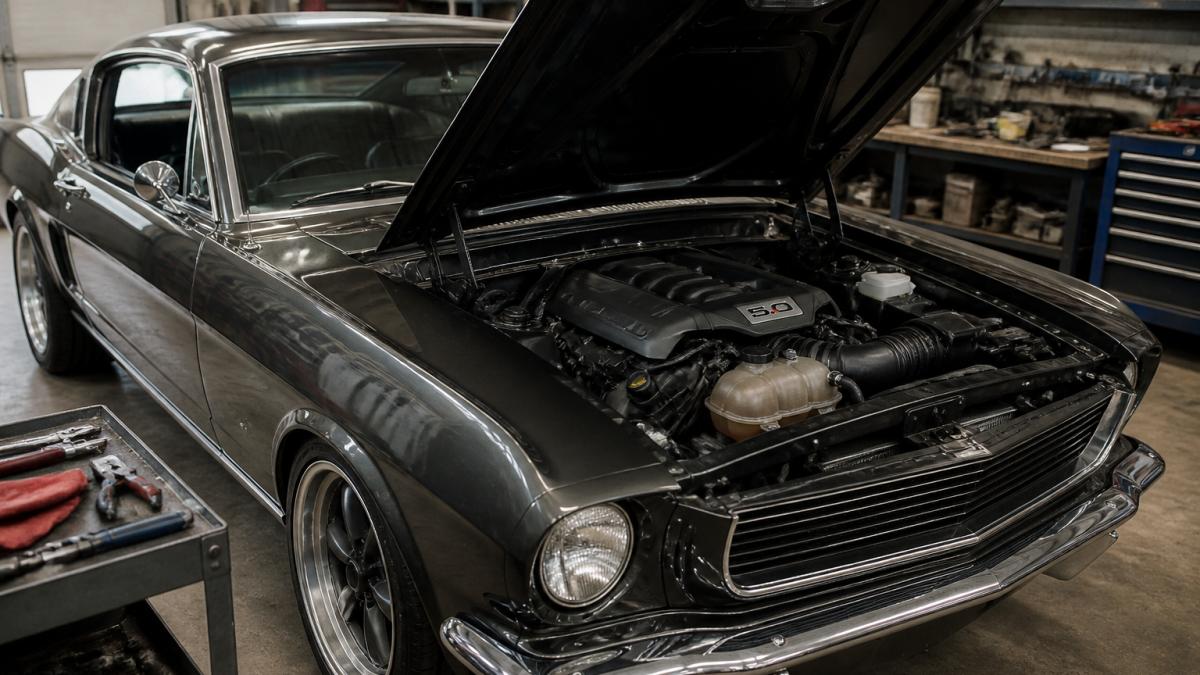
Ford Performance sells control packs for each Coyote generation, including a 2024 Coyote 5.0L control pack for manual transmissions that bundles the PCM, harness, throttle pedal, and OBD-II port. That single part removes a huge chunk of the wiring guesswork. The one thing to plan for: the Ford Performance calibration requires a return-style fuel system, so budget for a regulator, return line, and an in-tank pump designed for injection pressure.
Classic Mustang Engine Swap Kit: What's Included
A classic Mustang engine swap kit is the bundle of mounts, crossmembers, headers, and adapters that lets a modern engine sit in an old chassis. Kits vary wildly in completeness. Some include mounts and headers only; others add transmission crossmembers, driveshaft yokes, and wiring adapters. Read the parts list line by line before you buy, because "kit" is a loose word in this market.
If you prefer to stay pushrod-simple, a crate engine like the 363 cubic inch 507 HP Boss crate engine drops into a 302-sized package and uses standard small-block headers and accessory mounts, which keeps the swap kit simple. It makes 507 horsepower at 6,500 rpm and 450 lb.-ft. of torque at 5,100 rpm on premium pump gas. For a milder build, the 302 CI 340 HP Boss crate engine with the "E" cam is a forged-internals foundation that works with an automatic or manual and fits most Fox-body cars with its rear sump pan.


Classic Mustang Engine Swap Cost: Budget Breakdown
Most swap budgets fail because owners price the engine and forget the systems around it. A realistic planning range for a classic Mustang modern engine swap, assuming a shop handles fabrication and tuning, runs from roughly $25,000 on the low end for a pushrod crate and manual transmission to $45,000 or more for a Coyote build with an overdrive automatic and a rebuilt rear end.
| Category | Typical Range (USD) | What Drives the Number |
|---|---|---|
| Engine (crate or used Coyote) | $9,000-$16,000 | 302 crate at the low end; 363 or 572 crate at the high end; used Coyote in between |
| Control pack and ECU | $2,700-$3,500 | Ford Performance control pack by Coyote generation |
| Mounts, crossmember, headers | $1,500-$3,000 | Swap-specific vs. universal; long-tube headers cost more |
| Transmission and clutch/converter | $3,000-$6,000 | Six-speed manual vs. modern overdrive automatic |
| Fuel system (tank, pump, regulator, lines) | $1,200-$2,500 | Return-style injection requires pump, regulator, and return line |
| Cooling system (radiator, fan, shroud, hoses) | $800-$1,800 | Higher heat load from modern engine |
| Exhaust (headers back) | $1,000-$2,500 | Custom routing around steering box and towers |
| Wiring integration and dyno tuning | $1,500-$4,000 | Control pack reduces labor; custom harness increases it |
| Driveshaft and rear-end upgrade | $1,500-$4,000 | 8-inch rear is marginal behind 500 hp; 9-inch or built 8.8 is common |
| Brakes and suspension refresh | $1,000-$3,000 | Often deferred, rarely optional at modern power levels |
| Labor and fabrication | $5,000-$12,000 | Tower notching, tunnel massaging, custom mounts, tuning time |
The hidden costs are the ones that blow budgets. Shock-tower notching on a 1964.5-1966 car can add fabrication hours that no kit price reflects. A return-style fuel system requires a new tank or a sump, a regulator, and a return line, which most engine prices omit.
A practical planning rule: take the engine price, double it, and add labor. That rough formula lands most builders inside the realistic range and keeps the project from stalling halfway through. Get quotes for fabrication and tuning before you buy the engine, because those two line items vary most by shop and by model year.
Classic Mustang Swap Wiring and Engine Management
Classic Mustang swap wiring is where most projects stall, because the modern ECU expects sensors, a return-style fuel system, and a clean power distribution path that a 1960s harness was never designed to provide. The fix is a purpose-built control pack rather than a hacked factory harness. Ford Performance control packs include the PCM with calibration, the harness, an OBD-II port, and a power distribution module, which turns a weeks-long wiring job into a plug-and-play installation.
363 CUBIC INCH 507 HP BOSS CRATE ENGINE-Z2 HEADS-REAR SUMP PAN →
A few rules we follow on every build:
- Run a dedicated ground from the engine block to the chassis
- Keep the ECU power on its own fused circuit
- Use the OBD-II port for diagnostics from day one
- Have the calibration checked on a dyno before you trust the tune
That last point matters. A swap that runs but isn't dialed in will feel flat and can damage the engine over time. Tuning is not optional.
Transmission, Fuel, Cooling, and Exhaust Upgrades
The supporting systems decide whether the swap feels factory or cobbled together. Plan each one before the engine goes in:
- Transmission: Match the bellhousing to the engine and pick a transmission rated for the torque. Modern automatics and six-speed manuals both work; the adapter and crossmember are the fitment keys.
- Fuel: Return-style injection needs a pump, regulator, return line, and filter sized for the target horsepower.
- Cooling: A modern engine makes more heat. Upgrade the radiator, fan, and hoses together.
- Exhaust: Headers must clear the shock towers and steering. Buy swap-specific headers rather than forcing universal ones.
Budget the supporting systems first, then choose the engine. That order keeps the project realistic and prevents a beautiful engine from sitting on a stand while you wait on a fuel system.
Conclusion
The hard truth about a classic Mustang modern engine swap is that the engine is the easy decision and the supporting systems are the real project. Get the mounts, transmission, fuel, cooling, wiring, and tuning right, and you end up with a classic that starts every time and drives like a modern car.
That is exactly the work Paul's Automotive Engineering has done for Mustang and Ford owners since 1984. We are a licensed distributor for Ford Performance and other top-tier brands, we handle custom installation and dyno tuning, and we ship parts nationwide with clear communication. If you are planning a swap, email us to schedule your appointment and we will help you build the right parts list before you spend a dollar.
Frequently Asked Questions
What is the best modern engine swap for a classic Mustang?
The best choice depends on your goals. A Coyote 5.0L offers 435+ hp and modern drivability, while a Ford Performance crate engine like the 363 cubic inch 507 HP Boss provides a simpler carbureted setup with strong torque. For budget builds, a 302-based crate engine is a solid foundation. Consider your mechanical comfort, emissions rules, and whether you want fuel injection or carburetion before deciding.
Will a Coyote engine fit in a classic Mustang?
Yes, but it requires fabrication. The Coyote is wider and taller than a classic 289/302, so you will likely need shock tower modifications, a custom crossmember, and specific engine mounts. A classic Mustang engine swap kit for Coyote applications simplifies fitment. Expect to modify the transmission tunnel for modern automatics and upgrade the cooling system to handle the extra heat.
How much does a modern engine swap cost for a classic Mustang?
The cost for a classic Mustang engine swap varies significantly based on the engine and supporting parts. For example, a 302 CI 340 HP Boss crate engine is priced at $9,099.99, while a 363 cubic inch 507 HP Boss crate engine is $11,249.99, and a 572 cubic inch 655 HP Big Block Street crate engine is $15,999.99. A 2024 Coyote 5.0L Control Pack Manual Trans is $2,734.99. Labor costs will add to the total if you hire a shop.
What parts are needed for a Coyote swap in a classic Mustang?
You will need the Coyote engine, a control pack (like the 2024 Coyote 5.0L Control Pack Manual Trans), a compatible transmission, engine mounts, a modified crossmember, a high-capacity radiator, an electric fan, a return-style fuel system, headers, and a custom exhaust. Wiring integration is the most complex part; a dedicated harness and professional tuning are recommended for reliability.
Can you put a 4.6-liter engine in a classic Mustang?
Yes, a 4.6L modular V8 can fit, but it is wider than a pushrod engine and requires similar fabrication to a Coyote swap. You will need custom mounts, a transmission that mates to the modular bellhousing, and a wiring harness and ECU from the donor car or an aftermarket system. Space is tight, so careful measuring and test-fitting are essential.
Do classic Mustang engine swaps require transmission and wiring changes?
Almost always. Modern engines have different bellhousing patterns, so you will need a compatible transmission (e.g., T-56, 6R80, or AOD). Wiring is equally critical: fuel injection requires an ECU, sensors, and a harness. A classic Mustang swap wiring solution, such as a standalone harness or control pack, simplifies the job and ensures the engine runs correctly. Budget for both.
A classic Mustang with a modern heart is only as good as the planning behind it. Paul's Automotive Engineering brings over 100 years of combined experience to engine selection, custom installation, and dyno-verified tuning, backed by our status as a licensed distributor for Ford Performance and other leading brands. Email us to schedule your appointment and get your swap build sheet started.


Leave a comment