


Last Updated: November 4, 2026
Quick Summary
The f150 performance upgrades for towing that actually help are a weight-distribution hitch, a trailer brake controller, upgraded brake pads and fluid, and load support like air or helper springs. None of these raise your truck's rated capacity, but they make the rating you already have safe and usable.
- No bolt-on part raises your F-150's rated towing capacity, payload, or axle ratings.
- A weight-distribution hitch is the biggest handling upgrade for trailers over roughly 5,000 pounds.
- A trailer brake controller is not optional on heavy loads and many F-150s come pre-wired for one.
- Rear squat of more than about 1 to 2 inches loaded usually means you need load support.
- Spend on brakes and hitch setup before engine calibration, which does not change payload or axle ratings.
Table of Contents
- Why Towing Capacity, Payload, and Axle Ratings Come Before Power
- F-150 Towing Capacity Upgrades That Respect the Door Jamb Sticker
- F-150 Towing Suspension Upgrades for Squat, Sway, and Load Support
- F-150 Brake Upgrade for Towing: Stopping a Loaded Trailer
- F-150 3.5 EcoBoost Performance Upgrades and What They Do Not Change
- A Prioritized Upgrade Plan by F-150 Generation and Use Case
- Book Your F-150 Towing Upgrade Consultation
- Frequently Asked Questions
Why Towing Capacity, Payload, and Axle Ratings Come Before Power
Ford lists the 2026 F-150 maximum tow rating at up to 13,500 pounds, but that number only applies to one specific build. Ford notes that maximum towing varies with cargo, vehicle configuration, accessories, and passenger count, per Ford's 2026 F-150 towing information.
Here's the hard truth from Paul's Automotive Engineering: no bolt-on part raises your truck's rated capacity. Not one.
Four numbers decide what your F-150 can actually haul:
- Towing capacity: the most weight Ford rates your exact configuration to pull
- Payload: people, fuel, cargo, and tongue weight combined, per the door jamb sticker
- Tongue weight: how much the trailer pushes down on your hitch, typically 10-15% of trailer weight
- Axle rating: the most weight each axle can carry, front and rear separately
Your gross vehicle weight rating (GVWR) caps the truck itself. The gross combined weight rating (GCWR) caps truck plus trailer together.
Upgrades make the truck handle that load better. They don't change the sticker. That's the line every serious build starts from.
F-150 Towing Capacity Upgrades That Respect the Door Jamb Sticker
Real towing capacity upgrades fall into two groups: hardware that lets you use your existing rating safely, and support parts that make the load behave. Start with the hardware.
Hitches, Receivers, and Weight-Distribution Hitches
Check your hitch receiver's label before anything else. A hitch rated for 5,000 pounds conventional towing needs a weight-distribution hitch to reach higher ratings, and the ball itself has a limit too. Match ball size to your trailer coupler, and check the hitch rating against loaded trailer weight, not empty weight.
A weight-distribution hitch is the single biggest handling upgrade for trailers over roughly 5,000 pounds. It spreads tongue weight across both truck axles and the trailer axle, which levels the truck and fights trailer sway.
Trailer Brake Controllers and Trailer Brakes
A trailer brake controller is not optional on heavy loads. It syncs trailer brakes with your truck's brakes, and without it, stopping distances stretch badly. Many F-150s come pre-wired for a controller, so installation is often plug-and-play.
Inspect your trailer brakes before every season. Worn trailer brakes make every other upgrade moot.
F-150 Towing Suspension Upgrades for Squat, Sway, and Load Support
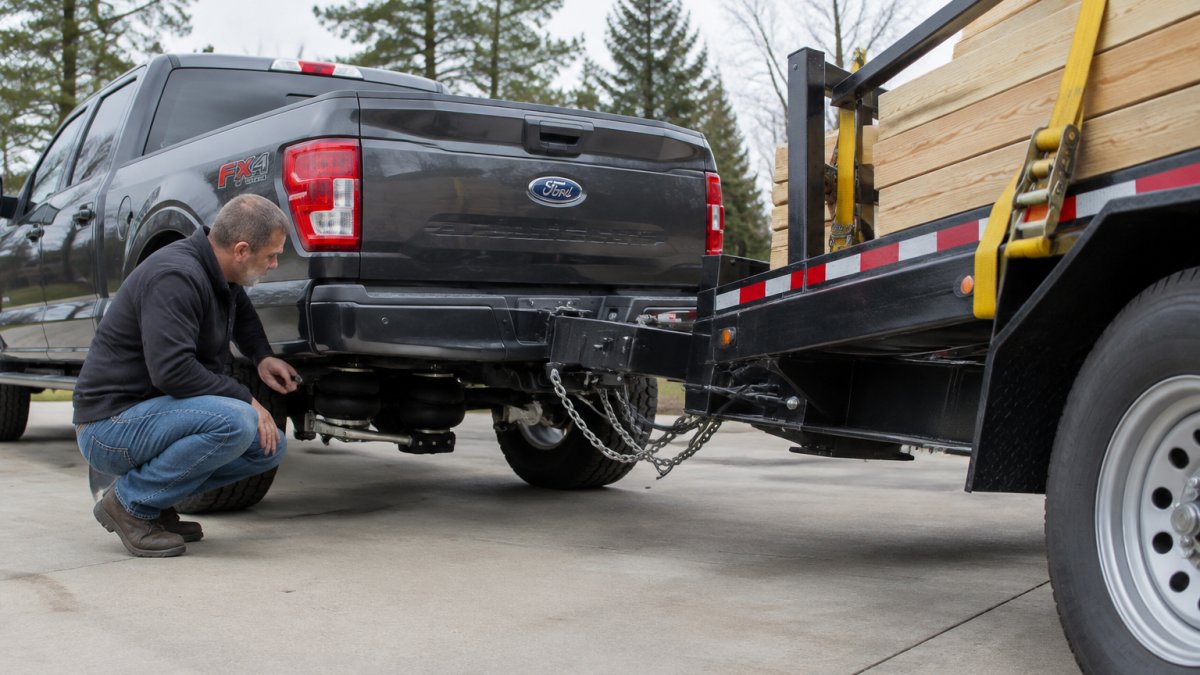
F-150 towing suspension upgrades fix symptoms: rear-end squat, trailer sway, and a floaty front end. They do not raise your rating. They make the rating you have usable.
Diagnose the symptom before you buy
Owners often buy suspension parts in the wrong order when they skip diagnosis. Load the truck and trailer the way you actually tow, then measure and observe:
- Rear squat: measure from the ground to the top of the rear wheel arch, loaded and unloaded. A drop of more than about 1 to 2 inches usually means you need load support, not more spring rate everywhere.
- Front-end float or light steering: if the front rises when the trailer is loaded, your weight-distribution hitch is likely set too loose or the tongue weight is too high for the truck's payload.
- Trailer sway: sway that starts above 55 mph and grows is usually a hitch setup or tongue-weight problem, not a spring problem. Fix the hitch first.
- Body roll in corners: a heavier rear sway bar helps, but it also changes unloaded handling, so match the bar to how often you tow.
Air springs, helper springs, and add-a-leaf springs
Air springs and helper springs add load support to the rear. They level the truck when the trailer drops the rear-end squat and restore ride height.
For a bolt-on helper bag kit, see our 2021-present F-150 helper bag kit for lowered applications. Air springs set too high can unload the rear axle and hurt stability. Level the truck, do not lift it.
Watch out: helper bags and add-a-leafs can change how the truck rides empty; check fitment notes for your cab, bed length, drivetrain, and tow package before ordering.
Bump stops, sway bars, and trailer sway control
Bump stops protect the suspension on hard hits, and upgraded bump stops help when you regularly tow near the payload limit on rough roads. Upgraded sway bars cut body roll and sharpen steering feel under load, but a stiffer rear bar can make the empty truck feel twitchy in rain or snow. Trailer sway control, built into many modern F-150s, applies brakes to fight sway, but it works best when your hitch setup is already right.
2021-2023 F-150 2.7L ECOBOOST PERFORMANCE CALIBRATION M-9603-F27 →
What suspension upgrades do not do
No air spring, helper spring, add-a-leaf, or sway bar raises your truck's GVWR, GCWR, payload, or axle ratings. The door jamb sticker and owner documentation are the authority. Suspension parts change how the load behaves, not what the truck is certified to carry. If a sales listing implies otherwise, treat that as a warning sign.
F-150 Brake Upgrade for Towing: Stopping a Loaded Trailer
An F-150 brake upgrade for towing is the most overlooked safety item on the build list. More power gets you moving. Brakes get you stopped.
Upgrade pads and rotors to handle heat, and flush brake fluid on schedule. Heat is the enemy when you're hauling down a grade. If your pedal feels soft after a long descent, your fluid is telling you something.
Pair brake upgrades with a working trailer brake controller. Truck brakes alone were never designed to stop a loaded trailer.
F-150 3.5 EcoBoost Performance Upgrades and What They Do Not Change
The 2026 3.5L PowerBoost hybrid V6 is reported to make 420 horsepower and 570 lb-ft of torque, with towing up to 11,600 pounds, per dealer-published 2026 figures. Ford's engine ratings follow SAE J1349 testing standards, per the 2025 Ford RV & Trailer Towing Guide.
More power helps you merge and climb. It does not raise your payload or axle rating.
Our 2021-2023 F-150 3.5L EcoBoost performance calibration adds 55 hp and 100 lb-ft on premium fuel. Pair it with an air-oil separator kit to protect the engine under sustained towing load. If you're weighing big power, read our guide on tuning F-150 horsepower safely first.

A Prioritized Upgrade Plan by F-150 Generation and Use Case
Spend money in this order. It is how we would build it, and it is organized so you can skip what your truck and trailer do not need. The plan assumes you have already checked the door jamb payload label and owner documentation, because no upgrade below changes your truck's certified ratings.
| Priority | Upgrade | Fixes | Rating Change |
|---|---|---|---|
| 1 | Weight-distribution hitch | Sway, squat | None |
| 2 | Trailer brake controller | Stopping distance | None |
| 3 | Brake pads and fluid | Heat fade | None |
| 4 | Air or helper springs | Rear-end squat | None |
| 5 | Sway bar upgrade | Body roll | None |
| 6 | EcoBoost calibration | Merge and climb power | None |
How to branch the plan by generation and configuration
- 2015-2020 F-150: many trucks in this range are daily drivers with higher miles. Brake fluid and pads first, then hitch hardware, then load support. Check for rust at the hitch and rear frame before adding air springs.
- 2021-present F-150: trucks with the max tow package often already have the hitch and cooling capacity; the common gap is a properly adjusted weight-distribution hitch and a trailer brake controller if the trailer has electric brakes.
- Regular cab, short bed: lighter and shorter wheelbase, so sway is more noticeable; prioritize the weight-distribution hitch and trailer sway control setup over power.
- Crew cab, long bed: more payload and a longer wheelbase, so load support and brake upgrades matter more than sway bars for most travel-trailer owners.
- 2.7L EcoBoost and 5.0L V8: both tow well within their ratings; spend on brakes and hitch setup before engine calibration.
- 3.5L EcoBoost and PowerBoost: more torque helps merge and climb, but the calibration is last because it does not change payload or axle ratings.
- Travel trailer vs. utility trailer: travel trailers have more frontal area and tongue weight, so weight distribution and sway control come first; utility trailers often need only a brake controller and correct ball mount.
A symptom-based shortcut
If the truck squats, go to priority 1 and 4. If stopping feels long, go to priority 2 and 3. If the trailer wanders, fix the hitch setup before buying any part. If the truck feels slow merging, that is the only symptom that points to priority 6.
Budget and trade-off notes
Spending on power first is common because it is the most visible upgrade. Brakes and hitch hardware are a sound place to start, especially on older trucks. Planning a supercharger? Our article on whether an F-150 supercharger kit is a DIY job covers the real scope.
Watch out: some suspension and calibration parts can affect warranty coverage and unloaded ride quality; have the work checked before your first loaded trip.
Book Your F-150 Towing Upgrade Consultation
Sorting your truck's actual ratings takes the door jamb sticker and owner's manual. Paul's Automotive Engineering has over 41 years of experience with Ford performance, and we are a licensed distributor for Whipple, Ford Racing, and other top brands.
Email us to schedule your appointment and get your F-150 towing setup dialed in before your next trip.
Frequently Asked Questions
Do performance tuners increase F-150 towing capacity?
No. A tuner can change how the truck delivers power, but it does not raise the manufacturer's rated capacity. Ford states that maximum towing varies with cargo, vehicle configuration, accessories, and passenger count. The 2026 F-150 is rated up to 13,500 pounds in the right configuration, and that number is set by the truck as built, not by a calibration. A Ford Performance calibration such as the 2021-2023 F-150 3.5L Performance Calibration ($654.99) improves throttle response and shift scheduling, but the door jamb sticker still governs payload and axle limits.
What are the most effective F-150 towing suspension upgrades?
Start with the symptom you actually have. Rear-end squat under tongue weight is usually addressed with air springs or helper springs, which add load support without changing the truck's rating. Trailer sway calls for a properly set weight-distribution hitch and a functioning sway control system before any spring change. Add-a-leaf springs suit trucks that carry loads regularly. Sway bars and bump stops round out the package. Match the part to the problem, and confirm compatibility with your F-150 generation and tow package.
What brake upgrades help an F-150 tow more confidently?
Trailer brakes matter more than truck brakes. Confirm the trailer has working brakes and that your trailer brake controller is set correctly for the load. On the truck side, fresh fluid, quality pads and rotors rated for heat, and correct tire pressure all contribute. A brake upgrade for towing is about heat management and consistency on long descents, not about shortening the truck's stopping distance beyond what the tires can deliver. Have the system inspected before adding power.
Can you increase an F-150's factory-rated towing capacity?
The manufacturer's rating is set by the vehicle configuration, and aftermarket parts do not change it. What upgrades can do is help the truck handle its rated load with more stability: a weight-distribution hitch, air springs for load support, sway control, and a trailer brake controller. Ford notes that maximum towing varies with cargo, accessories, and passenger count, so the practical approach is to weigh your loaded trailer, stay within payload and axle ratings, and upgrade for control rather than for a bigger number.
Your trailer isn't getting lighter, and the season won't wait. Let Paul's Automotive Engineering verify your ratings and build a towing setup that respects them, backed by expert installation and premium parts. Get started with Paul's Automotive Engineering and tow with confidence.


