


Last Updated: November 1, 2026
Quick Summary
To choose a Mustang supercharger, first confirm the kit fits your exact engine, generation and trim, then match the boost-delivery character to how you drive. Positive-displacement blowers deliver instant low-end torque for street cars, while centrifugal units build power toward redline for track use.
- Ford's 2026 Mustang GT and Dark Horse supercharger kit is designed to produce up to 800 horsepower.
- S550 covers 2015-2023 and S650 covers 2024 and later, with different engine bays and ECU strategies.
- For a street car, 550-650 horsepower is plenty and keeps drivability intact.
- Budget for fuel and cooling hardware, custom tuning, labor, and emissions compliance beyond the kit price.
- Tuning is typically required after install because the factory calibration does not account for added airflow.
Table of Contents
- Start With Your Mustang's Engine and Model Year
- Centrifugal vs Roots Supercharger Mustang Buyers Should Understand
- Match Mustang Supercharger Horsepower Gains to Your Real Goals
- What a Mustang Supercharger Cost Really Includes
- Mustang Supercharger Supporting Mods You Cannot Skip
- Tuning, Fuel, and Emissions After the Install
- Book a Supercharger Consultation With Paul's Automotive Engineering
- Frequently Asked Questions
Start With Your Mustang's Engine and Model Year
The first decision in learning how to choose a Mustang supercharger is not which brand makes the most power. It is which kit physically fits your car. A 2026 Mustang GT with the 5.0-liter V8 takes a different kit than a 2015 GT, and a Mach 1 takes a different kit again. Get this wrong and nothing downstream matters.
Ford's own approach shows where the market is heading. Ford says its 2026 Mustang GT and Dark Horse supercharger kit is designed to produce up to 800 horsepower, offered as a pre-installed, pre-delivery option for 2026 vehicles with the 5.0-liter engine (Ford's 2026 Mustang supercharger kit announcement). That is a factory-channel option, not a universal one.
Fitment breaks down into three checks:
- Engine: Coyote 5.0-liter V8, older modular V8, V6, or EcoBoost four-cylinder
- Generation: S550 (2015-2023) versus S650 (2024 and later) engine bay and ECU differences
- Trim: GT, Dark Horse, Mach 1, and Shelby variants each carry their own calibration
The model year decides the kit long before horsepower does.
Centrifugal vs Roots Supercharger Mustang Buyers Should Understand
A centrifugal supercharger is a belt-driven unit that looks like a turbocharger and builds boost with engine rpm, so power climbs toward redline. A roots supercharger sits on top of the intake and delivers strong low-end torque almost instantly. Those two sentences are where most guides stop. The useful part is what they mean for how the car actually drives.
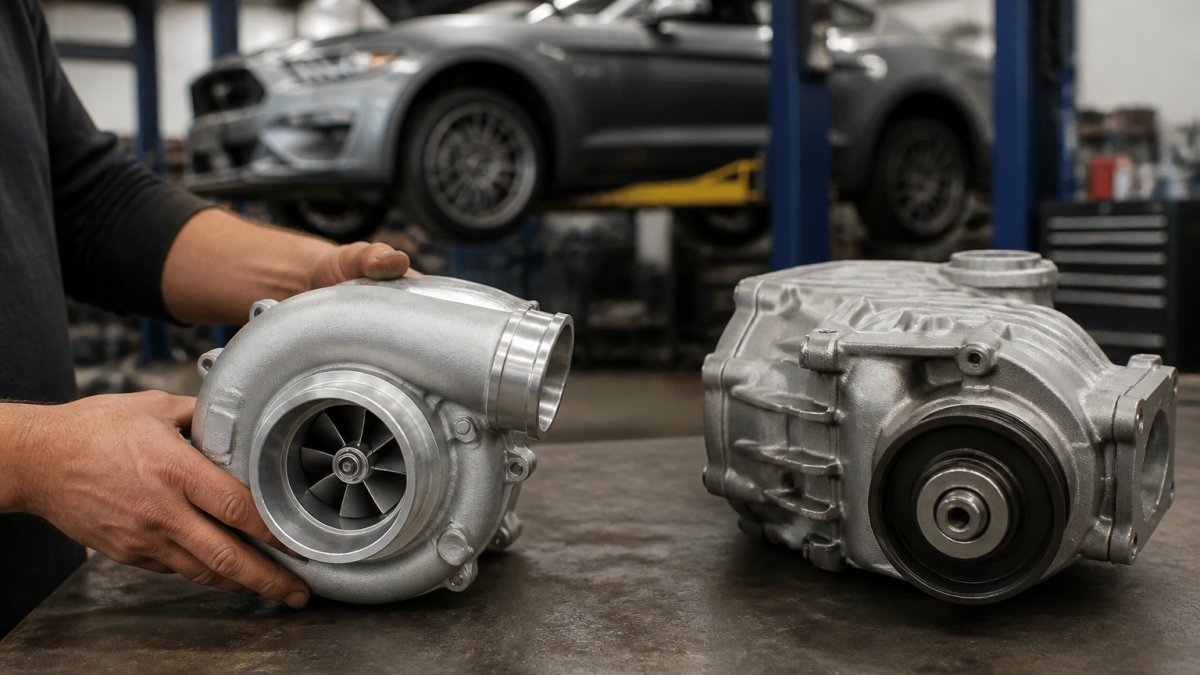
How boost arrives. A roots or twin-screw blower is positive displacement: it moves a fixed volume of air per revolution, so boost is available almost off idle and torque feels linear and immediate. A centrifugal unit's boost rises with the square of impeller speed, so the car feels close to stock at low rpm and then pulls hard as the tach climbs. On a Coyote 5.0-liter that revs willingly, the centrifugal character suits a car that is driven hard in the upper range; the positive-displacement character suits a car that is driven in traffic and wants the shove right now.
Twin-screw versus roots. Twin-screw blowers sit in the positive-displacement family with roots units but add thermal efficiency at higher boost, which matters once you push past mild pulley sizes. That efficiency shows up as lower intake temperatures and more consistent power on repeated pulls.
The decision framework. Rather than picking a type in the abstract, match it to the goal:
- Street car, stop-and-go, occasional spirited driving: positive-displacement (roots or twin-screw) for immediate torque and effortless part-throttle response.
- Track days and sustained high-rpm use: centrifugal for a powerband that builds toward redline, paired with serious heat management.
- Drag strip: either can work, but the choice changes how the car leaves the line, positive displacement for low-end hit, centrifugal for top-end charge.
- Towing, autocross, or a car that stays mostly stock-feeling below 3,000 rpm: positive displacement is the more natural fit.
Fitment by generation. The type you want and the type that fits are not always the same. S550 (2015-2023) and S650 (2024 and later) engine bays and ECU strategies differ, and trim level (GT, Dark Horse, Mach 1, Shelby) carries its own calibration.
If a roots-style kit fits your goals, the 2024-2026 S650 Stage 2 3.0L Whipple supercharger kit shows one positive-displacement setup. If a centrifugal unit matches your powerband preference, confirm generation support before you fall in love with the dyno graph.
Match the boost-delivery character to how you actually drive the car.
| Option | Best for | Key difference |
|---|---|---|
| Centrifugal supercharger | Track days and sustained high-rpm use | Boost builds with engine rpm, power climbs toward redline |
| Roots supercharger | Street car, stop-and-go, occasional spirited driving | Sits on top of the intake, strong low-end torque almost instantly |
| Twin-screw supercharger | Higher boost beyond mild pulley sizes | Positive displacement with thermal efficiency at higher boost |
| Positive displacement | Towing, autocross, car mostly stock-feeling below 3,000 rpm | Immediate torque and effortless part-throttle response |
| Either type | Drag strip | Choice changes how the car leaves the line |
Match Mustang Supercharger Horsepower Gains to Your Real Goals
Mustang supercharger horsepower gains are the number buyers fixate on, and the least useful number in isolation. Manufacturer-reported maximums are not promises about your car.
Be honest about the goal:
- Street car: 550-650 horsepower is plenty and keeps drivability intact
- Drag strip: peak output matters, but so does how the power arrives off the line
- Track days: heat management and sustained output beat a single dyno pull
The honest limitation: not every owner needs forced induction.
What a Mustang Supercharger Cost Really Includes
Mustang supercharger cost is a total-system question, not a parts-catalog question. The head unit is one line item. The rest is where budgets quietly break.
Build the budget in five layers:
Email to schedule your appointment →
- The kit itself. Price depends on tier (Stage 1 vs. Stage 2), blower displacement, and generation, and quotes vary with these factors.
- Supporting fuel and cooling hardware. Higher-flow injectors, a pump that keeps up, a larger heat exchanger, and an intercooler pump. On a stock-fuel car this layer is not optional, and it is the layer buyers most often under-budget.
- Custom tuning and dyno time. A dyno session with a competent calibrator is a real line item, not a favor. Budget for multiple pulls and a revision or two.
- Labor for installation. Kit install time varies by generation and by whether the car already has supporting work. Positive-displacement blowers that sit on the intake and centrifugal kits that mount on the accessory drive do not share a labor profile.
- Emissions compliance and post-install sorting. 50-state-legal status, any required hardware, and the follow-up visit to chase a drivability niggle.
Supporting hardware and tuning can add significant cost beyond the kit itself, so plan the full system before ordering.
Do not budget from a kit's advertised price alone. Ask for an installed-cost estimate that itemizes fuel, cooling, tuning, labor, and compliance, then compare that total across two or three kit options rather than comparing sticker prices. :::
We do not publish prices for kits or installs, because they shift with tier, model year, and what your car already has. Contact us for a current quote built as a full system, not a box. The right question is not "what does the blower cost" but "what does a sorted, tuned, reliable car cost", and that answer is specific to your model year and your starting point.
Mustang Supercharger Supporting Mods You Cannot Skip
Mustang supercharger supporting mods decide whether the car survives its new power. Skip them and you are borrowing reliability you will repay later.
The essentials:
- Fuel system: higher-flow injectors and a pump that keeps up with demand
- Cooling: upgraded heat exchanger and intercooler pump to fight heat soak
- Spark and air: colder plugs and an intake that flows enough
- Driveline: clutch or converter upgrades once torque climbs
A common mistake is bolting on a blower and stopping there. If you want to see what the full job involves, our step-by-step Mustang supercharger install guide walks through the supporting work.
Tuning, Fuel, and Emissions After the Install
Tuning is typically required after a supercharger install, because the factory calibration does not account for the added airflow. Custom dyno tuning sets fuel, timing, and boost to match the hardware and fuel.
Fuel quality matters, and the tune should be built around the fuel you will use. Emissions is the other gate: 50-state-legal kits exist, and a kit without that status can create registration headaches. Ask before you buy, not after.
To see what a proper dyno session actually gains you, read our Mustang dyno tuning breakdown.
Book a Supercharger Consultation With Paul's Automotive Engineering
Choosing the right supercharger is a fitment, fuel, and tuning decision wearing a horsepower costume. Get those three right and the power takes care of itself.
At Paul's Automotive Engineering, we have specialized in Mustang and Ford performance since 1984, with over 100 years of combined experience and licensed distributor status for Whipple, ProCharger, Vortec, Ford Racing, and more.
Email us to schedule your appointment and get your build planned around your goals, your model year, and your budget.
Frequently Asked Questions
What type of supercharger is best for a Mustang?
There is no single best type. A roots or twin-screw blower builds boost almost instantly, which suits street driving and stoplight-to-stoplight response. A centrifugal unit, like the ProCharger-style systems, builds boost with rpm and pulls hardest near redline, which fits drag-strip and track use. Match the type to how you actually drive the car, then confirm the kit covers your engine and model year.
How much horsepower can a supercharger add to a Mustang?
Manufacturer-reported maximums are not guarantees for every car. Your real gain depends on the kit, pulley and boost level, fuel, and the tune. Ask for a dyno result on a comparable car before you commit to a number.
What supporting mods does a supercharged Mustang need?
At minimum, plan for a custom tune, higher-flow fuel components, and a heat exchanger or intercooler setup sized to the boost you run. The supporting mods list should be written before the kit is ordered, not after the first dyno pull, because each part affects what the next one can safely handle.
How much does it cost to supercharge a Mustang?
Pricing depends on the kit, the power tier, and the labor your car needs, so get a written quote rather than a catalog number. The kit price is only part of it. Budget for installation, a custom tune, fuel system upgrades, and any supporting mods your power goal requires. Ask the shop to itemize parts and labor separately so you can see what each stage adds. Paul's Automotive Engineering can quote your specific build by email.
The hard part is not picking a supercharger. It is picking the one your car, your fuel, and your tuner can actually support. That is the conversation we have with every owner before a single part is ordered. Get started with Paul's Automotive Engineering and build a Mustang that makes power you can trust.


