


Last Updated: November 8, 2026
Quick Summary
Mustang performance parts installation cost is shop rate multiplied by billed hours, so it varies by part, generation, and existing modifications rather than a single flat figure. Bolt-on jobs like a cat-back exhaust cost far less than headers or a supercharger, which add K-member work, supporting mods, and dyno calibration. Always give the shop your exact year, engine, transmission, and mod list for an accurate quote.
- Labor hours come from published book time for standard jobs and from inspection for custom or combination work.
- Long-tube headers may require dropping or loosening the K-member, which adds time and possibly an alignment afterward.
- A supercharger install adds a full day or more of skilled labor plus calibration on a dyno.
- A tune is part of the installation budget, not an optional add-on after a performance install.
- DIY suits cat-back exhausts and cold air intakes, but headers, superchargers, and engine swaps are not driveway jobs.
Table of Contents
- Why Mustang Performance Parts Installation Cost Varies So Much
- Mustang Performance Parts Labor Cost: How Shop Rates and Hours Add Up
- Mustang Long-Tube Headers Installation Cost: Parts, Labor, and What Drives the Bill
- Mustang Supercharger Installation Cost: Kits, Labor, and Supporting Mods
- Mustang Tuning Cost: Why the Tune Is Part of the Installation Budget
- Hidden and Follow-Up Costs That Show Up After the Install
- DIY vs. Professional Installation: Where the Savings Actually Are
- Warranty, Emissions, and Street-Legal Questions to Settle Before You Buy
- Frequently Asked Questions
Why Mustang Performance Parts Installation Cost Varies So Much
Mustang performance parts installation cost is not a single number, and any shop that quotes you one flat figure without seeing the car is guessing. Two seemingly identical S550 GT installs can differ in cost by a large margin, and the reason is often not the part itself.
The gap comes from three variables: what the part demands of the chassis, how many hours the job actually takes versus what a book says, and how much supporting work the combination needs to stay reliable. A cat-back exhaust is a bolt-on afternoon. A supercharger is a system, and systems have dependencies.
Below, we break down realistic parts-and-labor ranges, explain how shops build an installation quote, and show you where hidden costs hide. The short version: labor scales with access, not with horsepower.
Mustang Performance Parts Labor Cost: How Shop Rates and Hours Add Up
Mustang performance parts labor cost is shop rate multiplied by billed hours, but both halves of that equation move enough that two quotes for the same job can differ by hundreds of dollars. Understanding how each half is built is the difference between accepting a fair estimate and overpaying for access work.
Typical Shop Rates and How Labor Hours Are Estimated
Shop labor rates vary by market and by the type of shop. Performance work typically demands specific tooling, lift access, dyno time, and calibration skill, which is reflected in labor pricing. Ask any shop for its current rate.
Hours get estimated three ways. Labor hours are estimated from published book time for standard jobs and from inspection for custom or combination work, since packaging and prior modifications change access. Ask any shop to break the estimate into parts, labor hours, and hourly rate. If they cannot or will not, that is your signal to keep shopping.
Why the Same Job Costs More on Some Mustangs Than Others
A 2011-2014 Coyote and a 2024 S650 share a nameplate and almost nothing else in the engine bay. Older cars bring seized fasteners, brittle plastic, and rust that turns a two-hour job into an extraction project. Newer cars bring tighter packaging and more electronics to recalibrate. Body style matters too: a convertible adds bracing and trim removal, a car with an aftermarket K-member changes header access, and a previously modified car can add hours before the first wrench turns because the shop has to map what is already there.
Drivetrain and engine choice shift the estimate as well. A V6 or EcoBoost car often needs different connection pipes and mounting hardware than a Coyote GT, and a car with an automatic transmission may require cooler or line work that a manual does not. The practical takeaway: give the shop your exact year, engine, transmission, and a list of existing modifications before you ask for a number. A quote built on "a Mustang" is not a quote for your Mustang. With those details in hand, compare each labor and parts line against the work proposed, since a clear estimate from Happy Wallet Quality Auto Repair can help you spot assumptions before approving the job.
For a deeper look at vetting installers and comparing estimates, see our guide on how to choose a performance shop for your Mustang.
Mustang Long-Tube Headers Installation Cost: Parts, Labor, and What Drives the Bill
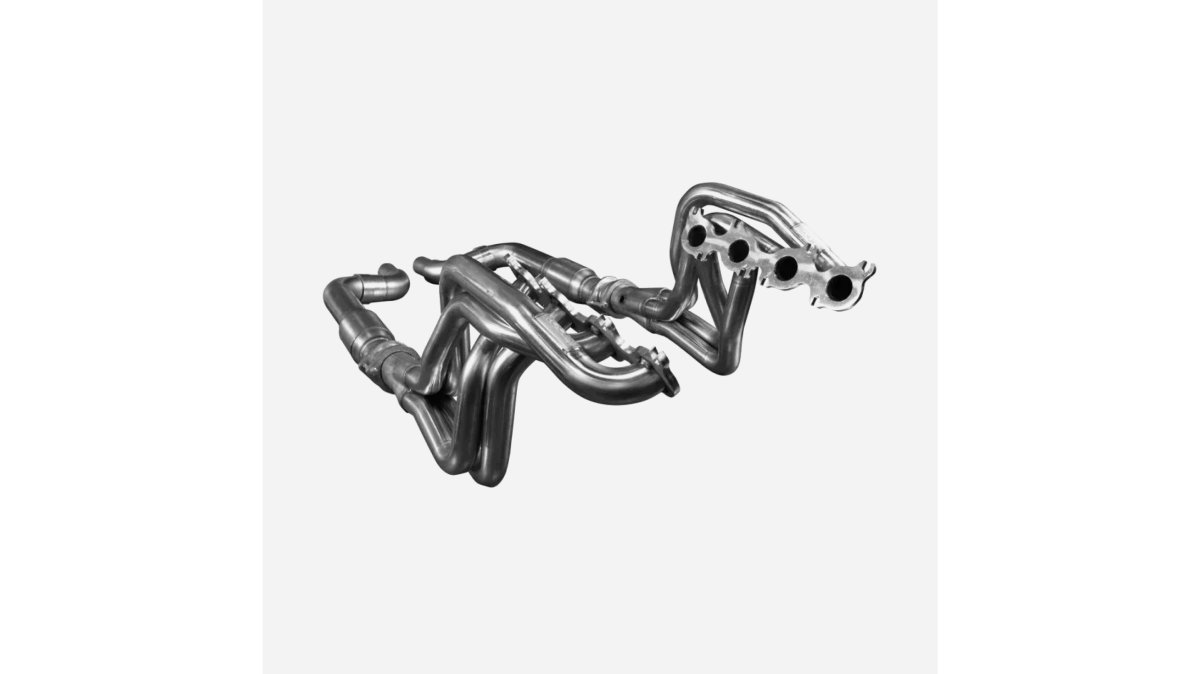
Long-tube headers are the classic example of a part where labor can rival the hardware. The job requires lifting the car, dropping or loosening the K-member on many generations, wrestling with tight primary-tube clearance, and often reworking the connection pipes to mate with the factory cat-back. Rusted manifold studs turn a straightforward swap into an extraction project.
What the Parts Cost
Header pricing varies by brand, material, primary-tube diameter, and whether catted connection pipes are included. The 2" Stainless Headers & H.O. GREEN Cat. Conn. Kit for 2015-2026 Mustang GT/Dark Horse includes gaskets, oxygen sensor extension harness, clamps, and bolt kit required for installation.
What the Labor Costs
Labor depends heavily on generation and access. On some cars the K-member must be dropped or loosened, which adds time and may require an alignment afterward. Tight primary-tube clearance can mean test-fitting and adjusting before final torque.
Ask whether the quote includes a re-torque visit and an alignment if the K-member was moved, since these may not be included.
Model-Specific Fitment Notes
Fitment is where estimates go wrong. A 2015+ S550 GT with a Coyote has different header clearance than an S197 with a 4.6L or a 5.0L Coyote, and EcoBoost and V6 cars use different connection-pipe layouts entirely. A convertible or a car with an aftermarket K-member changes access again. Give the shop your exact year, engine, and transmission, and confirm the headers are listed for that combination before you schedule the install.
Mustang Supercharger Installation Cost: Kits, Labor, and Supporting Mods
Supercharger installation is the biggest line item most owners face, and the kit price is only the entry fee. A complete kit includes the head unit, manifold, intercooler, fuel system upgrades, and hardware. Installation adds a full day or more of skilled labor, plus calibration on a dyno. Supporting mods are where budgets quietly blow: upgraded oil pump gears, a crank sprocket, colder plugs, and sometimes a fuel pump booster.

The Whipple S650 Stage 1 Gen 6 3.0L supercharger kit is one option to consider when comparing kits. Choosing the right kit for your goals matters as much as the install itself, so read our guide on how to choose a Mustang supercharger for your build before you commit.
Mustang Tuning Cost: Why the Tune Is Part of the Installation Budget
A tune is not an optional add-on after a performance install; it is part of the installation. Bolt on a supercharger or a tune-required intake without recalibrating the ECU and you get a car that runs poorly, throws codes, or worse. Calibration is what makes the hardware work together, and it belongs in the same budget line.
Tune-required parts make this obvious. Our JLT cold air intake for 2018-2023 Mustang GT states plainly that a tune is required, because the MAF scaling changes with the larger housing. A custom tune is calibrated to the exact combination of parts and conditions. This is the difference between a car that makes power safely and one that makes a noise.
Hidden and Follow-Up Costs That Show Up After the Install
The estimate is rarely the final bill, and smart owners plan for the gap. Common follow-ups include:
- Alignment after suspension or K-member work
- Fluids and consumables not folded into the quote
- Re-torque and leak checks after the first heat cycles
- Emissions readiness if your state runs OBD-II testing
- Shipping and core charges on large parts
Ask for a written quote that lists what is included and, just as important, what is not. A shop that itemizes exclusions is being honest with you.
DIY vs. Professional Installation: Where the Savings Actually Are
DIY saves money on bolt-on parts and costs money on anything requiring calibration or engine access. A cat-back exhaust or a cold air intake is a driveway job with jack stands and basic hand tools. Headers, superchargers, and engine swaps are not, unless you have a lift, torque specs, and a way to tune the result.
Here is how we would decide:
| Job Type | DIY Feasible? | Why |
|---|---|---|
| Cat-back exhaust | Yes | Bolt-on, no tuning |
| Cold air intake | Yes, with tune | Needs calibration |
| Long-tube headers | No | K-member and clearance work |
| Supercharger kit | No | Calibration and supporting mods |
| Engine swap | No | Fabrication and tuning |
A common mistake is starting a header job in a driveway and discovering the K-member drop mid-way. In practice, the savings evaporate when you pay for a tow.
Warranty, Emissions, and Street-Legal Questions to Settle Before You Buy
Warranty and emissions are the two questions owners ask last and should ask first. Modifications can affect factory warranty coverage on related components, and emissions compliance depends on whether your parts retain functioning catalytic converters and meet your state's inspection rules.
Street-legal use matters too. Catless headers are generally intended for off-road use; catted connection pipes help maintain emissions compliance. Confirm with your installer what your local inspection requires before you spend, and ask how the install is documented.
The real challenge with Mustang performance parts installation cost is that the cheapest quote is rarely the cheapest outcome. A shop that understands calibration, warranty, and emissions saves you money over the life of the build. Paul's Automotive Engineering brings over 42 years of dedicated service and over 100 years of combined experience, and we are a licensed distributor for Kooks Headers, Whipple, Hellion Turbo, TiAL Sport, Vortec, Procharger and Ford Racing. Email Paul's Automotive Engineering to schedule your appointment.
Frequently Asked Questions
What affects the labor cost of installing Mustang performance parts?
Four things move the number most: the part itself, the model year and engine, whether the car needs supporting mods, and the shop's hourly rate. Long-tube headers on a Coyote take far more time than a cat-back because the factory manifolds have to come off and clearance is tight. A supercharger adds tuning and often fuel-system work. Older or engine-swapped cars can add fabrication hours. Ask for labor hours and the shop rate separately so you can compare quotes on the same basis.
Do Mustang performance upgrades require a tune?
Most airflow-changing parts do. Headers, high-flow inlets, and superchargers alter how much air the engine sees, and the factory calibration will not account for it. Skipping the tune leaves power on the table and can trigger check-engine lights or lean conditions. Budget for Mustang tuning cost as part of the install, not as an optional extra, and confirm the shop doing the install is the one writing or loading the tune so the whole combination is validated together.
Can installing aftermarket parts affect a Mustang's warranty?
Under the Magnuson-Moss Warranty Act, a dealer cannot void your whole warranty just because aftermarket parts are installed. They can deny a specific claim if they can show the modification caused the failure. Ask your shop what warranty comes with the parts and what they provide in writing about the install.
Is it cheaper to buy the parts myself and have a local shop install them?
Sometimes on paper, rarely in practice. Buying your own parts can save markup, but you own the fitment risk and the warranty paperwork, and many shops will not stand behind a calibration on parts they did not supply. A bad fit or wrong tune on supercharger and header jobs can cost more to fix than any markup you avoided.


